
Basic English Sentence Structure: A Complete Guide for Beginners
Lesson 3 of 11 (27%)
Introduction
Do you want to improve your English speaking and writing but don’t know where to start?
The answer is simple: basic English sentence structure.
Many learners struggle with English not because they lack vocabulary, but because they don’t understand how to form correct sentences. Without proper structure, even simple ideas become difficult to express.
The good news is that English sentence structure is not complicated. Once you understand the basic patterns, you can start creating your own sentences confidently.
In this article, you will learn the fundamentals of basic English sentence structure, along with examples, tips, and practice exercises to help you improve quickly.
Learning Objectives
After reading this article, you will be able to:
- Understand what basic English sentence structure is
- Identify the main parts of a sentence
- Form correct sentences using simple patterns
- Avoid common sentence mistakes
- Build confidence in speaking and writing
What Is Basic English Sentence Structure?
A sentence is a group of words that expresses a complete idea.
In English, most sentences follow a simple structure:
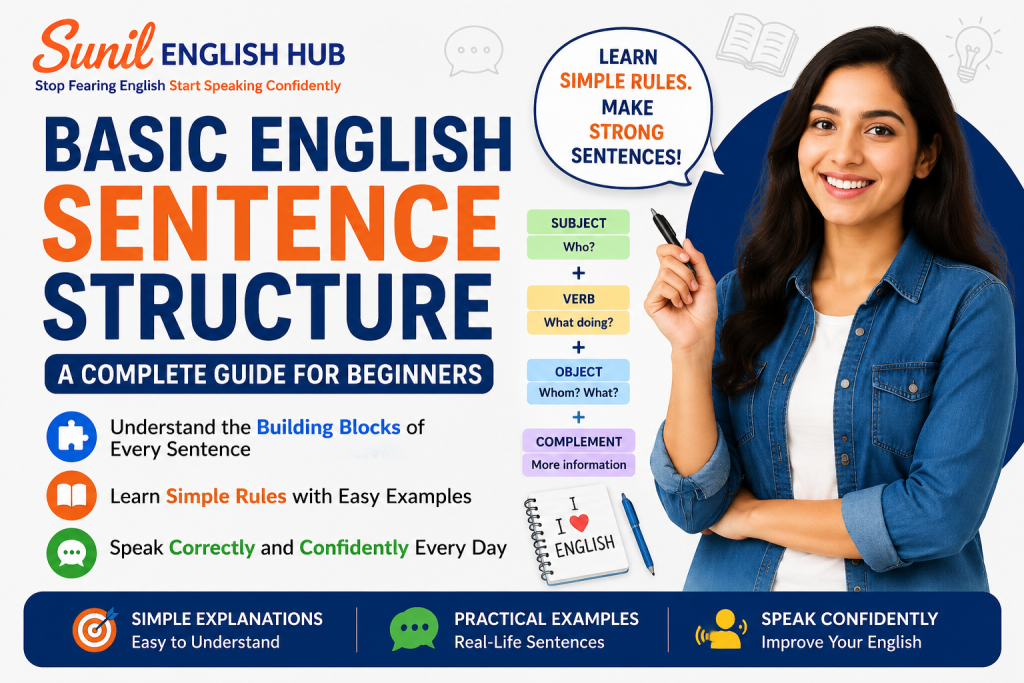
👉 Subject + Verb + Object (SVO)
This is the most common and important pattern.
- Subject = Who or what is doing the action
- Verb = The action
- Object = Who or what receives the action
👉 Example:
- “She reads a book.”
Here:
- She = Subject
- reads = Verb
- a book = Object
Why Is Sentence Structure Important?
If your sentence structure is wrong:
- People may not understand you
- Your message becomes confusing
- Your confidence decreases
👉 Correct structure helps you:
- Speak clearly
- Write correctly
- Communicate effectively
Basic Sentence Patterns
Let’s explore the most important sentence structures.
1. Subject + Verb (SV)
This is the simplest structure.
👉 Example:
- “She runs.”
- “They laugh.”
No object is needed
2. Subject + Verb + Object (SVO)
This is the most common structure.
👉 Example:
- “I eat rice.”
- “He plays football.”
3. Subject + Verb + Complement (SVC)
A complement gives more information about the subject.
👉 Example:
- “She is happy.”
- “They are students.”
4. Subject + Verb + Object + Complement (SVOC)
👉 Example:
- “They made him captain.”
Examples of Sentence Structure
Example 1: Daily Life
👉 “I wake up early.”
👉 “I go to office.”
👉 “I complete my work.”
Example 2: Workplace
👉 “I am writing a report.”
👉 “She is attending a meeting.”
Example 3: Simple Conversation
👉 “Where are you going?”
👉 “I am going home.”
Common Mistakes (Very Important)
❌ Wrong:
“He go to school.”
✅ Correct:
“He goes to school.”
👉 Reason: Verb must agree with subject.
❌ Wrong:
“I am go to market.”
✅ Correct:
“I am going to the market.”
❌ Wrong:
“She very happy.”
✅ Correct:
“She is very happy.”
Tips to Improve Sentence Structure
1. Start with Simple Sentences
Don’t try complex sentences immediately.
👉 Use:
- I eat
- I go
- I work
2. Practice Daily
Make at least 5 sentences every day.
👉 Example:
- I drink tea
- I read a book
3. Think in English
Avoid translation.
👉 Instead of:
Thinking in Bangla → Translating
👉 Think directly:
“I am tired today.”
4. Learn Patterns, Not Rules
Focus on patterns like:
- S + V + O
- S + V
This makes learning easier.
5. Read and Listen More
Exposure helps you understand structure naturally.
Examples (Practice Section)
Convert these into correct sentences:
👉 “She / eat / rice”
✔ She eats rice
👉 “They / play / football”
✔ They play football
👉 “He / is / teacher”
✔ He is a teacher
Takeaway
- Every English sentence has a structure
- The most common structure is Subject + Verb + Object
- Simple sentences are powerful
- Practice daily to improve
- Avoid overthinking grammar
👉 Clear structure = clear communication
Quiz (Test Your Understanding)
1. What is the basic English sentence structure?
a) Verb + Subject
b) Subject + Verb + Object
c) Object + Verb
d) Subject + Object
2. Identify the subject in this sentence: “She writes a letter.”
a) writes
b) letter
c) she
d) a
3. Which sentence is correct?
a) He go to school
b) He goes to school
c) He going school
d) He gone school
4. What is the verb in this sentence: “They play football.”
a) They
b) play
c) football
d) none
Answers:
- b
- c
- b
- b
Summary
Understanding basic English sentence structure is the foundation of learning English.
- A sentence expresses a complete idea
- The most common structure is Subject + Verb + Object
- Simple sentences help you start speaking
- Regular practice improves fluency
- Correct structure builds confidence
👉 If you want to speak English confidently, start with simple sentences and practice every day.