
Introduction to IELTS Speaking: A Beginner’s Guide to Success
Lesson 7 of 11 (64%)
Introduction
Are you planning to take the International English Language Testing System exam but feel nervous about the speaking test?
You are not alone.
Many candidates fear the speaking module because they think they need perfect grammar, a foreign accent, or advanced vocabulary to score well.
The truth is different.
The IELTS Speaking test does not measure perfection. It measures how effectively you communicate in English.
With the right understanding and regular practice, you can perform confidently.
In this article, you will get a complete introduction to IELTS Speaking, understand how the test works, what examiners look for, common mistakes to avoid, and practical strategies to improve.
Learning Objectives
By the end of this article, you will be able to:
- Understand the format of the IELTS Speaking test
- Know what happens in each part of the exam
- Understand the scoring criteria
- Learn strategies to improve your speaking performance
- Build confidence for IELTS preparation
What Is IELTS Speaking?
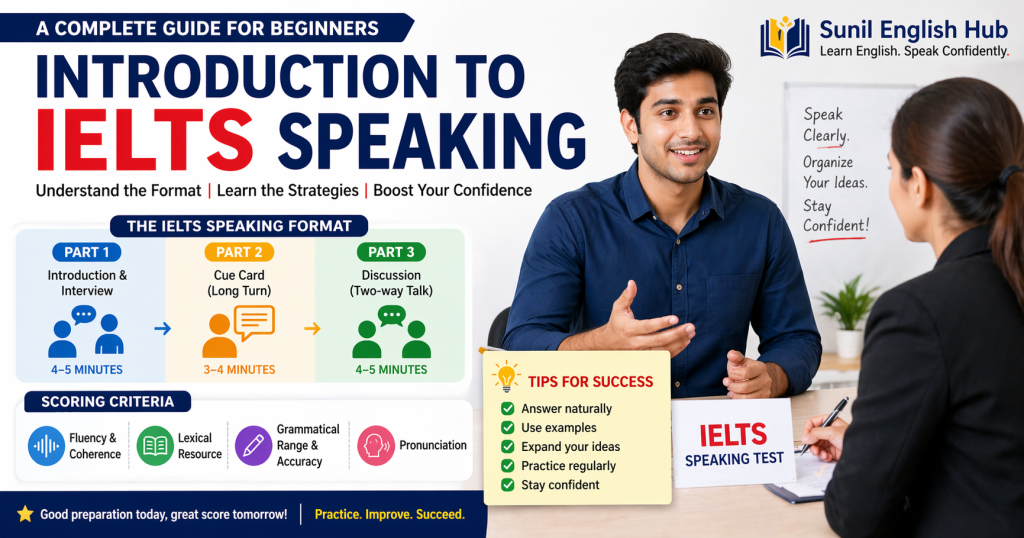
The IELTS Speaking test is a face-to-face interview with an examiner.
It lasts approximately 11–14 minutes.
It is designed to assess your ability to communicate naturally in English.
The examiner evaluates:
- Fluency
- Coherence
- Vocabulary
- Grammar
- Pronunciation
👉 Important:
This is not a test of memorization.
It is a test of communication.
Structure of IELTS Speaking
The test has three parts.
Part 1: Introduction and Interview (4–5 Minutes)
This part includes simple personal questions.
Topics may include:
- Hometown
- Family
- Studies
- Work
- Hobbies
- Food
- Travel
Example Questions
- Where do you live?
- What do you do?
- Do you enjoy reading?
Example Answer
Question:
Do you enjoy reading?
Answer:
Yes, I do. I especially enjoy reading non-fiction books because they help me learn new ideas.
👉 Tip:
Give more than one-word answers.
Avoid:
“Yes.”
Better:
“Yes, I do, especially…”
Expand your answers naturally.
Part 2: Cue Card (Long Turn) (3–4 Minutes)
You receive a topic card.
You get:
- 1 minute to prepare
- 1–2 minutes to speak
Example Cue Card
Describe a memorable journey you took.
You should say:
- Where you went
- Who you went with
- What happened
- Why it was memorable
Strategy for Part 2
Use simple structure:
- Introduction
- Details
- Feelings
- Conclusion
This helps coherence.
Part 3: Discussion (4–5 Minutes)
This is a deeper discussion related to Part 2.
Questions are more analytical.
Example:
- Why do people travel?
- How has tourism changed?
- Should governments support tourism?
Here the examiner checks your ability to discuss ideas.
Not just describe.
How IELTS Speaking Is Scored
Speaking is scored from Band 0–9.
Examiners use four criteria.
1. Fluency and Coherence
Can you speak smoothly?
Can you organize ideas logically?
Good fluency does not mean speaking fast.
It means speaking naturally.
2. Lexical Resource
This means vocabulary.
Can you use a range of words appropriately?
Not difficult words.
Appropriate words.
A strong vocabulary is essential for a high IELTS score. Explore our guide on Vocabulary for Daily Conversation.
3. Grammatical Range and Accuracy
Can you use grammar correctly?
Use varied sentence structures.
Simple + complex.
Understanding Basic English Sentence Structure helps you form clear and grammatically correct answers.
4. Pronunciation
Can people understand you clearly?
Accent is not the issue.
Clarity is.
👉 Important:
You do not need a British accent.
You need understandable pronunciation.
Common Mistakes Candidates Make
❌ Giving Very Short Answers
Bad:
Do you like music?
Yes.
Good:
Yes, I do. I listen to music every day, especially classical and folk music.
❌ Memorized Answers
Examiners can detect memorized responses.
Sound natural.
Not rehearsed.
❌ Speaking Too Fast
Fast does not mean fluent.
Speak clearly.
❌ Using Difficult Words Incorrectly**
Simple correct vocabulary is better than complex wrong vocabulary. Expanding your vocabulary through our 10 Words, 10 Days series can significantly improve your speaking performance.
Tips to Improve IELTS Speaking
1. Practice Speaking Every Day
Even 15 minutes daily helps.
Consistency matters.
Avoiding Common Spoken English Mistakes can help you achieve a higher band score.
2. Record Yourself
Listen to:
- Fluency
- Grammar mistakes
- Pronunciation
Self-correction is powerful.
3. Extend Your Answers
Don’t stop after one sentence.
Add:
- Reason
- Example
- Opinion
This improves band score.
4. Learn Topic Vocabulary
Study vocabulary for:
- Education
- Environment
- Technology
- Travel
- Culture
Topic vocabulary helps in Part 3.
5. Use the “Why + Example” Technique
Statement
Reason
Example
Excellent for longer answers.
Example:
I enjoy reading because it broadens my perspective. For example, historical books teach me how societies changed.
Sample IELTS Speaking Responses
Part 1 Example
Question:
Do you enjoy cooking?
Answer:
Yes, I do. I especially enjoy cooking traditional dishes during weekends because it helps me relax.
Part 2 Example Opening
I would like to talk about a memorable trip I took to Cox’s Bazar with my family.
Part 3 Example
I believe tourism benefits countries economically because it creates jobs and promotes cultural exchange.
Takeaway
- IELTS Speaking is a communication test
- It has three parts
- Fluency matters more than perfection
- Simple natural answers can score well
- Regular practice builds confidence
To improve your fluency, regularly practise Basic English Conversation in real-life situations.
👉 Speak naturally, not perfectly.
Quick Quiz
1. How many parts are there in the IELTS Speaking test?
2. Which skill is NOT assessed in the IELTS Speaking test?
3. In Part 2 of the IELTS Speaking test, candidates usually speak for:
4. Which of the following can help improve your IELTS Speaking score?
5. Which criterion is used by IELTS examiners to assess speaking performance?
Summary
The IELTS Speaking test may seem intimidating, but understanding the format changes everything.
- It has three parts
- Examiners assess communication skills
- Fluency, vocabulary, grammar, and pronunciation matter
- Natural speaking performs better than memorized speech
- Daily practice leads to improvement
Remember:
You do not need perfect English.
You need confident, clear communication.
👉 Start practicing today, and the speaking test will become far less frightening.
FAQ
Q1: Can I get a high score with simple English?
Yes. Clear and natural communication can score highly.
Q2: Is accent important in IELTS Speaking?
No. Clarity matters more than accent.
Q3: How can I improve quickly?
Practice daily, record yourself, and answer common IELTS questions.
Learning Daily Use English Sentences can help you answer IELTS Speaking questions more naturally.
Final Thought
Success in IELTS Speaking is not about sounding like a native speaker.
It is about showing you can communicate ideas confidently.
And that can be learned.
👉 Speak every day, improve step by step, and trust the process.