
IELTS Speaking Part 1: Common Questions and Sample Answers
Lesson 11 of 11 (100%)
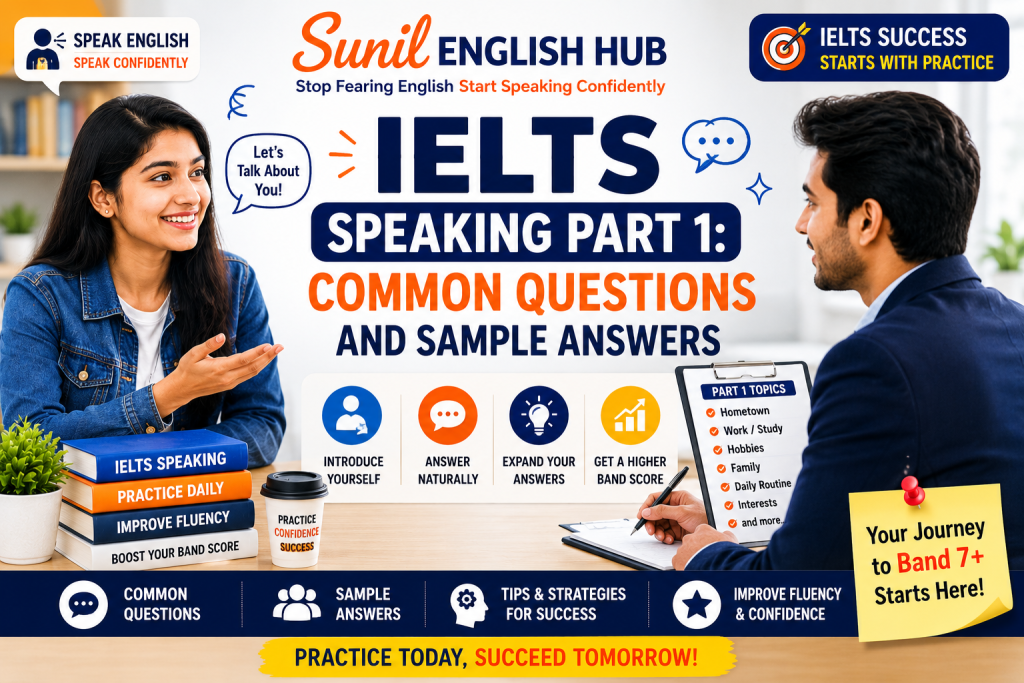
The IELTS Speaking test is one of the most important parts of the IELTS examination. Many candidates worry about Speaking because they are afraid of making mistakes or speaking in front of an examiner. However, IELTS Speaking Part 1 is actually the easiest section of the speaking test because it focuses on familiar topics from your daily life.
In this lesson, you will learn the structure of IELTS Speaking Part 1, discover common question types, study sample answers, and learn practical strategies to improve your confidence and band score.
Learning Objectives
- Understand the format of IELTS Speaking Part 1.
- Learn common IELTS Speaking Part 1 topics.
- Study sample answers for frequently asked questions.
- Improve fluency and confidence in speaking.
- Avoid common mistakes that reduce IELTS scores.
What Is IELTS Speaking Part 1?
IELTS Speaking Part 1 is the first section of the Speaking test. It usually lasts between 4 and 5 minutes. During this stage, the examiner asks simple questions about familiar topics such as your home, studies, work, hobbies, family, hometown, and daily routines.
According to the official IELTS website, Part 1 focuses on everyday topics and allows candidates to talk about themselves in a natural way. Official IELTS Speaking Information.
If you are completely new to IELTS, read our guide: What Is IELTS? Everything Beginners Need to Know.
Structure of IELTS Speaking Part 1
The examiner usually follows three stages:
- Greeting and identity verification
- Questions about familiar topics
- Several follow-up questions on each topic
For example, the examiner may ask:
- What is your name?
- Do you work or study?
- Tell me about your hometown.
- What do you do in your free time?
The goal is not to test your knowledge. The examiner wants to see how naturally and accurately you can communicate in English.
Topic 1: Hometown
Question 1: Where is your hometown?
Sample Answer:
My hometown is Jashore, which is located in the south-western part of Bangladesh. It is known for its rich culture, educational institutions, and agricultural activities. I have lived there for most of my life, and I feel very connected to the place.
Question 2: What do you like about your hometown?
Sample Answer:
I like the peaceful environment and the friendly people in my hometown. Life is less stressful than in large cities, and there are many green areas that make the environment pleasant.
Topic 2: Work or Study
Question 1: Do you work or study?
Sample Answer:
I currently work as a Program Manager for a development organization. My responsibilities include project planning, monitoring activities, and coordinating with different stakeholders.
Question 2: What do you enjoy most about your work?
Sample Answer:
I enjoy solving problems and working with different people. It is rewarding to see the positive impact of our projects on communities.
Topic 3: Hobbies
Question 1: What do you do in your free time?
Sample Answer:
In my free time, I enjoy reading books, learning new skills online, and creating educational content for English learners. These activities help me relax while also improving my knowledge.
Question 2: Do you prefer indoor or outdoor activities?
Sample Answer:
I prefer indoor activities because they allow me to focus and learn without distractions. However, I also enjoy occasional outdoor walks to stay healthy.
Topic 4: Reading
Question 1: Do you enjoy reading books?
Sample Answer:
Yes, I do. Reading helps me expand my vocabulary and learn new ideas. I particularly enjoy books related to education, communication, and personal development.
Question 2: What kind of books do you like?
Sample Answer:
I mostly read educational books and biographies because they provide practical knowledge and inspiration.
Topic 5: Daily Routine
Question 1: What is your typical day like?
Sample Answer:
My day usually starts early in the morning. I check emails, plan my work schedule, attend meetings, and complete project-related tasks. In the evening, I spend time reading or working on my English-learning website.
To talk about daily routines effectively, it is useful to understand the tense-easy-rules-examples-practice-for-beginners/">Present Simple Tense.
Common Mistakes in IELTS Speaking Part 1
1. Giving Very Short Answers
Bad Answer: “Yes.”
Better Answer: “Yes, I do. I enjoy reading because it helps me learn new things and improve my vocabulary.”
2. Memorizing Answers
Examiners can easily recognize memorized responses. Speak naturally instead.
3. Speaking Too Fast
Many candidates believe fast speaking sounds fluent. In reality, clear and natural speech is more effective.
4. Using Difficult Vocabulary Incorrectly
Use vocabulary that you understand well rather than trying to impress the examiner with unfamiliar words.
How IELTS Speaking Is Assessed
The IELTS Speaking test is evaluated according to four criteria:
- Fluency and Coherence
- Lexical Resource (Vocabulary)
- Grammatical Range and Accuracy
- Pronunciation
The British Council explains that these four criteria are used to determine your Speaking band score. IELTS Speaking Assessment Criteria.
Tips to Get a Higher Band Score
- Speak in complete sentences.
- Give reasons and examples.
- Practice speaking every day.
- Expand your vocabulary.
- Listen to English podcasts and interviews.
- Record yourself and review your performance.
To improve your speaking confidence, read How to Start Speaking English Without Fear.
You can also strengthen your vocabulary through Vocabulary for Daily Conversation.
Useful Expressions for IELTS Speaking Part 1
- As far as I know…
- In my opinion…
- Personally, I think…
- One reason is that…
- For example…
- I would say that…
These expressions help make your answers sound more natural and organized.
Takeaway
IELTS Speaking Part 1 is designed to assess your ability to talk about familiar topics. The questions are simple, but your answers should be detailed, natural, and confident. Focus on fluency, vocabulary, grammar, and pronunciation. Most importantly, avoid memorized answers and practise speaking regularly.
Quiz: Test Your Understanding
1. How long does IELTS Speaking Part 1 usually last?
2. Which topic is commonly asked in Part 1?
3. Which is a common mistake?
4. Which criterion is used to assess IELTS Speaking?
5. What is the best way to improve speaking?
📖 Show Answer Key
Answer Key
- 4–5 minutes
- Hometown
- Giving very short answers
- Fluency and Coherence
- Practising regularly