
Common Spoken English Mistakes: A Complete Guide to Speaking Correctly and Confidently
Lesson 5 of 11 (45%)
Learning Objectives
By the end of this lesson, you will be able to:
- Identify common spoken English mistakes made by learners
- Understand why these mistakes happen
- Correct your own speaking errors confidently
- Speak more natural and fluent English in daily conversations
Introduction
Many learners of English feel nervous while speaking—not because they don’t know English, but because they are afraid of making mistakes. Interestingly, most spoken English mistakes are common, predictable, and easy to fix.
In countries like Bangladesh and India, some incorrect expressions have become so widely used that they sound “normal,” even though they are not correct in standard English.
This guide will help you recognize those mistakes and replace them with correct, natural English expressions. Remember: English is a language, not a subject to fear.
Why Do We Make Spoken English Mistakes?
Before correcting mistakes, it is important to understand their causes:
- Mother tongue influence (Bangla interference)
- Direct translation from Bangla to English
- Lack of real-life speaking practice
- Learning from incorrect sources (movies, local usage, etc.)
The good news is: once you become aware of these mistakes, you can fix them quickly.
Top Common Spoken English Mistakes (With Corrections)
Let’s explore some of the most common mistakes:
1. ❌ “I did a mistake” → ✅ “I made a mistake”
👉 Why?
In English, we use “make” with “mistake,” not “do.”
✔ Correct:
- I made a mistake in my exam.
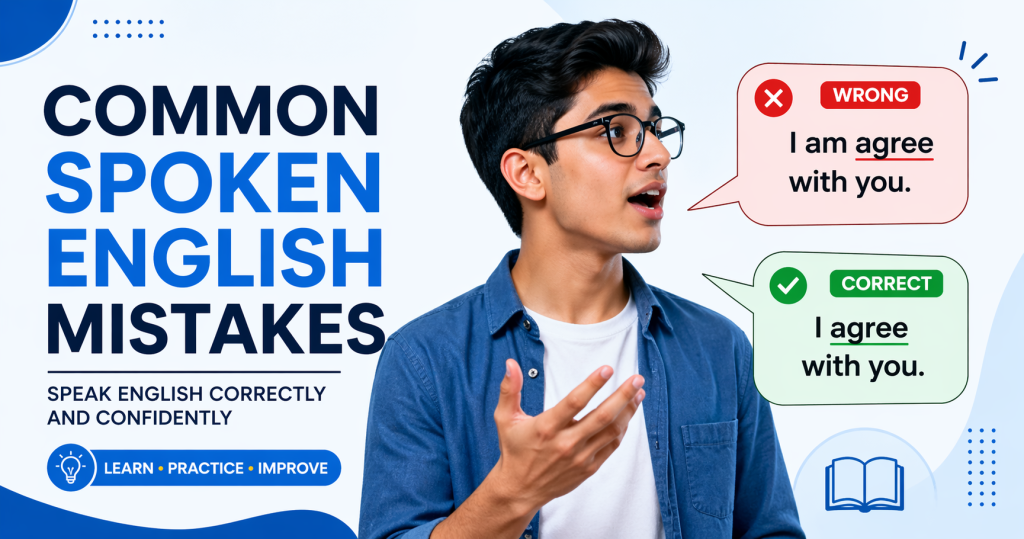
2. ❌ “I am agree” → ✅ “I agree”
👉 Why?
“Agree” is a Verb, not an Adjective.
✔ Correct:
- I agree with you.
3. ❌ “He gave an exam” → ✅ “He took an exam”
👉 Why?
Students take exams; teachers give exams.
✔ Correct:
- I took the IELTS exam last week.
4. ❌ “Discuss about the issue” → ✅ “Discuss the issue”
👉 Why?
“Discuss” does not need “about.”
✔ Correct:
- Let’s discuss the problem.
5. ❌ “Return back” → ✅ “Return”
👉 Why?
“Return” already means “go back.”
✔ Correct:
- He returned home late.
6. ❌ “I am coming” (on phone) → ✅ “I’m on my way”
👉 Why?
“I am coming” can sound unnatural in this context.
✔ Correct:
- I’m on my way.
7. ❌ “Open the light” → ✅ “Turn on the light”
👉 Why?
We don’t “open” lights.
✔ Correct:
- Please turn on the light.
8. ❌ “Close the fan” → ✅ “Turn off the fan”
✔ Correct:
- Turn off the fan before leaving.
9. ❌ “I am having two brothers” → ✅ “I have two brothers”
👉 Why?
We don’t use “having” for possession in this case.
✔ Correct:
- I have two sisters.
10. ❌ “What is your good name?” → ✅ “What is your name?”
👉 Why?
“Good name” is not used in standard English.
✔ Correct:
- What is your name?
Mistakes in Daily Conversations (Real-Life Examples)
Let’s see how these mistakes appear in real situations:
❌ Wrong:
- I am agree with you. Let’s discuss about this tomorrow.
✅ Correct:
- I agree with you. Let’s discuss this tomorrow.
❌ Wrong:
- I did a mistake in the exam.
✅ Correct:
- I made a mistake in the exam.
👉 Practice tip:
Try correcting your own sentences every day.
How to Avoid These Mistakes
Here are some practical strategies:
✅ 1. Think in English (Not in Bangla)
Avoid direct translation.
Instead of:
👉 Bangla → English
Try:
👉 Idea → English
✅ 2. Learn Common Phrases (Chunks)
Don’t learn word-by-word. Learn phrases like:
- Make a mistake
- Take an exam
- Turn on/off
✅ 3. Practice Speaking Daily
Even 10 minutes a day can improve your fluency.
✅ 4. Listen to Correct English
Use:
- BBC Learning English
- YouTube lessons
- Native speakers’ conversations
✅ 5. Record Yourself
Speak and listen to your own voice.
You will notice your mistakes instantly.
Pro Tip: Don’t Fear Mistakes
Making mistakes is not a problem—it is part of learning.
👉 The real problem is:
- Not speaking
- Not correcting yourself
Remember:
“The more mistakes you make, the faster you learn.”
Quick Practice Quiz
Choose the correct sentence:
a) I did a mistake
b) I made a mistake
a) Discuss about it
b) Discuss it
a) Open the light
b) Turn on the light
👉 Answers: 1(b), 2(b), 3(b)
Conclusion
Spoken English mistakes are very common, but they are also very easy to fix. Once you understand the correct usage, your confidence will increase automatically.
Don’t try to speak perfect English—try to speak clear and correct English.