
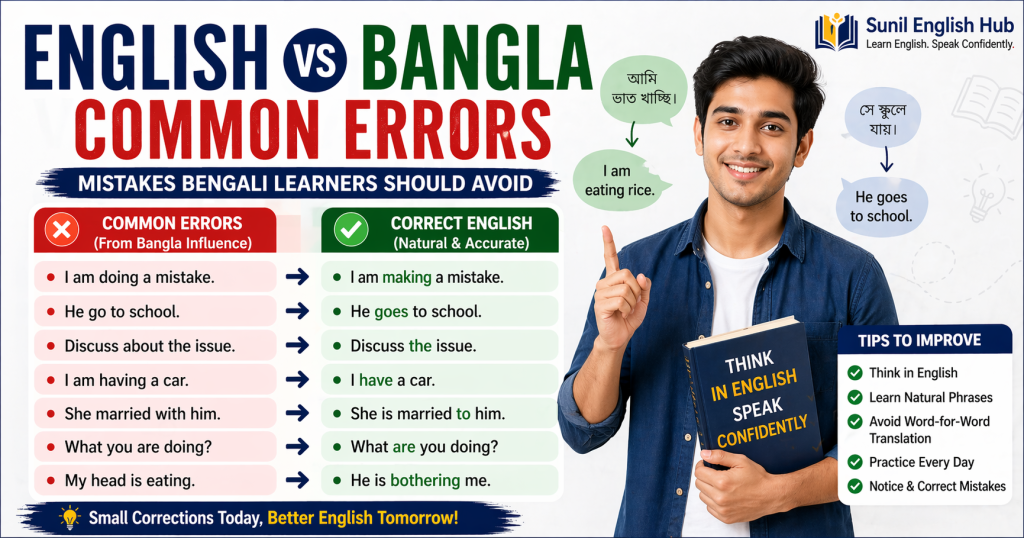
English vs Bangla Common Errors: Mistakes Bengali Learners Should Avoid
Lesson 8 of 8 (100%)
Introduction
Have you ever translated a sentence directly from Bangla into English and felt something sounded wrong?
You are not alone.
Many Bengali learners make mistakes in English not because they do not know grammar, but because they often transfer Bangla patterns directly into English.
This is called language interference.
It happens when the structure, vocabulary, or expressions of one language influence another.
For Bengali speakers, this creates many common errors in spoken and written English.
The good news?
Once you recognize these mistakes, they become much easier to correct.
In this article, you will learn common English vs Bangla errors, why they happen, how to avoid them, and how to build more natural English.
Learning Objectives
By the end of this article, you will be able to:
- Identify common English mistakes Bengali learners make
- Understand why these errors occur
- Correct translation-based mistakes
- Speak and write more natural English
- Build awareness for self-correction
Why Do Bangla Speakers Make These Errors?
Often learners translate word-for-word.
But languages do not work like mirrors.
Bangla and English have different:
- Word order
- Verb patterns
- Articles
- Prepositions
- Idioms
- Collocations
Direct translation often creates unnatural English.
👉 Good English is not translated Bangla.
It is English thought expressed naturally.
Common English vs Bangla Errors
1. Word-for-Word Translation Errors
❌ Wrong:
I am taking rice.
(ভাত নিচ্ছি)
✅ Correct:
I am eating rice.
❌ Wrong:
Give an exam.
✅ Correct:
Take an exam / Sit for an exam.
❌ Wrong:
I am doing mistake.
✅ Correct:
I am making a mistake.
👉 Reason:
Some Bangla verb combinations do not match English collocations.
Learn natural word combinations.
2. Article Errors (a, an, the)
Articles cause trouble because Bangla does not use them the same way.
❌ Wrong:
He is teacher.
✅ Correct:
He is a teacher.
❌ Wrong:
Sun rises in east.
✅ Correct:
The sun rises in the east.
Tip
Use:
- a/an for general singular nouns
- the for specific nouns
3. Subject-Verb Agreement Errors
Very common.
❌ Wrong:
He go to school.
✅ Correct:
He goes to school.
❌ Wrong:
My friend live in Dhaka.
✅ Correct:
My friend lives in Dhaka.
Remember:
He/She/It → usually takes verb + s/es.
4. Preposition Errors
Bangla and English often use different prepositions.
❌ Wrong:
Discuss about the issue.
✅ Correct:
Discuss the issue.
❌ Wrong:
Married with her.
✅ Correct:
Married to her.
❌ Wrong:
Good in English.
✅ Correct:
Good at English.
Prepositions must often be memorized.
5. tense Errors
Direct translation causes tense problems.
❌ Wrong:
I am knowing him.
✅ Correct:
I know him.
❌ Wrong:
I am having two brothers.
✅ Correct:
I have two brothers.
Some verbs usually do not take continuous form.
6. Bengali Style Questions
❌ Wrong:
What you are doing?
✅ Correct:
What are you doing?
❌ Wrong:
Where you went?
✅ Correct:
Where did you go?
English questions need auxiliary verbs.
7. Unnatural Bengali Expressions in English
❌ Wrong:
My head is eating.
(মাথা খাচ্ছে)
✅ Better:
He is bothering me.
❌ Wrong:
My body is bad.
✅ Correct:
I am feeling unwell.
Literal translation often creates strange English.
Examples in Real-Life Situations
At Work
❌ Kindly do the needful and revert back.
(Common South Asian business English)
✔ Please take the necessary action and reply.
In Conversation
❌ I am coming in five minutes.
(when leaving)
✔ I will be back in five minutes.
Daily Life
❌ Open the light.
✔ Turn on the light.
Why Correcting These Errors Matters
Correcting these mistakes helps you:
- Sound natural
- Speak confidently
- Avoid misunderstanding
- Improve writing
- Perform better in interviews and exams
Small corrections create major improvement.
How to Avoid Translation Errors
1. Think in English
Don’t build English through Bangla.
Think directly in English.
Instead of translating:
ভাবুন → English sentence.
2. Learn Phrases, Not Just Words
Don’t learn:
make
mistake
Learn:
make a mistake
Learn chunks.
3. Notice Native Usage
Read and listen carefully.
Notice how real English works.
4. Keep an Error Notebook
Write:
Wrong:
Discuss about
Correct:
Discuss
Review regularly.
5. Self-Correct Daily
Catch one mistake daily.
Fix one mistake daily.
Huge long-term improvement.
Mini Error Correction Practice
Correct these:
- He don’t know me.
✔ He doesn’t know me.
- I am having a car.
✔ I have a car.
- She married with a doctor.
✔ She is married to a doctor.
Takeaway
- Direct translation causes many errors
- Bangla and English follow different patterns
- Learn natural English expressions
- Focus on phrases and collocations
- Correcting small mistakes improves fluency enormously
👉 Natural English grows when translation dependence decreases.
Quick Quiz
1. Which sentence is correct?
2. Which sentence uses the correct English structure?
3. Which sentence is grammatically correct?
4. Which sentence is the natural English expression?
5. Which sentence correctly translates the Bangla idea?
Summary
Many English mistakes Bengali learners make come from direct translation.
But these mistakes are fixable.
Remember:
- Avoid word-for-word translation
- Watch articles and prepositions
- Learn natural collocations
- Practice self-correction
- Think in English, not translated Bangla
Good English is often not about difficult grammar—
It is about avoiding common mistakes.
👉 Correct less. Communicate better.
FAQ
Q1: Why do Bengali speakers make these errors?
Because Bangla structures often influence English.
Q2: How can I reduce translation mistakes?
Think in English and learn phrases instead of isolated words.
Q3: Are these mistakes common in IELTS Speaking too?
Yes, many of these errors affect fluency and grammar scores in International English Language Testing System speaking.
Final Thought
Fluent English does not come only from learning more vocabulary.
It often comes from removing common errors.
Sometimes improving means not adding more—
but correcting what is already there.
👉 Notice the mistakes. Fix them one by one. Fluency will follow.