
Narration in English Grammar: Direct and Indirect Speech Explained
Lesson 1 of 2 (50%)
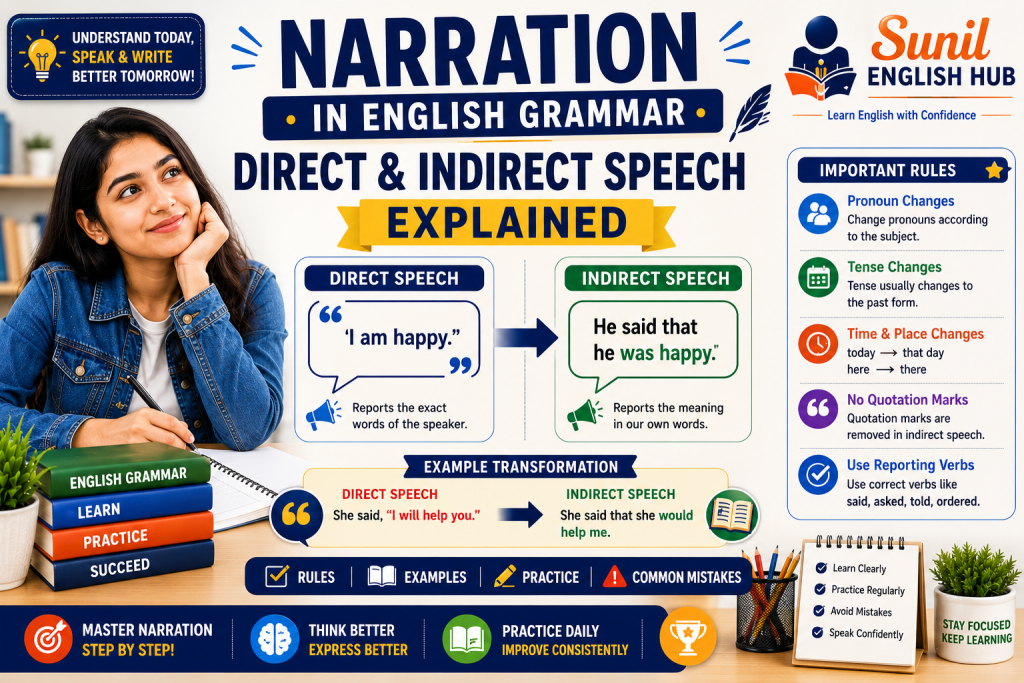
Narration, also known as Direct and Indirect Speech, is an important part of English grammar. It helps us report what someone has said without always repeating the exact words. Narration is widely used in everyday conversation, storytelling, journalism, academic writing, and examinations.
Many English learners find narration challenging because changing a sentence from direct speech to indirect speech often involves changes in tense, pronouns, reporting verbs, and time expressions. However, once you understand the basic rules, narration becomes much easier.
In this lesson, you will learn what narration is, the difference between direct and indirect speech, important rules, examples, common mistakes, and practical tips for mastering reported speech.
Learning Objectives
- Understand what narration means in English grammar.
- Learn the difference between direct and indirect speech.
- Identify the parts of a narration sentence.
- Apply the basic rules of changing direct speech into indirect speech.
- Avoid common mistakes in narration.
What Is Narration?
Narration is the process of reporting or describing what someone has said. It can be done in two ways:
- Direct Speech
- Indirect Speech (Reported Speech)
According to traditional English grammar, direct speech repeats the exact words of the speaker, while indirect speech reports the meaning without necessarily using the speaker’s exact words.
What Is Direct Speech?
Direct Speech repeats the exact words spoken by a person.
Example:
Rahim said, “I am tired.”
Here, the exact words of Rahim are placed inside quotation marks.
Direct speech usually contains:
- A reporting clause
- A reported clause inside quotation marks
What Is Indirect Speech?
Indirect Speech reports the meaning of what someone said without quoting the exact words.
Example:
Rahim said that he was tired.
In indirect speech, quotation marks disappear and the sentence structure changes according to narration rules.
Parts of a Narration Sentence
A direct speech sentence generally consists of two parts:
- Reporting Clause
- Reported Speech
Example:
He said, “I will help you.”
Reporting Clause: He said
Reported Speech: “I will help you.”
Difference Between Direct and Indirect Speech
| Direct Speech | Indirect Speech |
|---|---|
| Uses quotation marks | No quotation marks |
| Reports exact words | Reports meaning |
| More common in conversations | More common in reports and writing |
| Rahim said, “I am busy.” | Rahim said that he was busy. |
Why Is Narration Important?
Narration is essential because we often need to report what people say.
For example:
- News reporters report interviews.
- Teachers report students’ responses.
- Writers report conversations in stories.
- Students answer grammar questions in exams.
Narration is especially important for learners preparing for school examinations, competitive exams, and English proficiency tests.
Basic Rules of Changing Direct Speech into Indirect Speech
Rule 1: Remove Quotation Marks
Direct: He said, “I am happy.”
Indirect: He said that he was happy.
Rule 2: Change Pronouns
Pronouns often change according to the subject and object.
Direct: She said, “I love my country.”
Indirect: She said that she loved her country.
Rule 3: Change Tense (When Necessary)
If the reporting Verb is in the past tense, the tense of the reported speech usually moves one step back.
| Direct Speech | Indirect Speech |
|---|---|
| Present Simple | Past Simple |
| Present Continuous | Past Continuous |
| Present Perfect | Past Perfect |
| Will | Would |
| Can | Could |
Direct: He said, “I work hard.”
Indirect: He said that he worked hard.
To understand tense changes better, read Tense: ইংরেজি ভাষার প্রাণ.
Rule 4: Change Time and Place Expressions
| Direct Speech | Indirect Speech |
|---|---|
| today | that day |
| tomorrow | the next day |
| yesterday | the previous day |
| now | then |
| here | there |
Direct: He said, “I will come tomorrow.”
Indirect: He said that he would come the next day.
Examples of Direct and Indirect Speech
| Direct Speech | Indirect Speech |
|---|---|
| She said, “I am reading.” | She said that she was reading. |
| He said, “I have finished my work.” | He said that he had finished his work. |
| They said, “We will help you.” | They said that they would help me. |
| Rahim said, “I can swim.” | Rahim said that he could swim. |
Cases Where Tense Does Not Change
Tense usually does not change in the following situations:
1. Universal Truth
Direct: The teacher said, “The sun rises in the east.”
Indirect: The teacher said that the sun rises in the east.
2. Scientific Facts
Direct: The scientist said, “Water boils at 100°C.”
Indirect: The scientist said that water boils at 100°C.
Reporting Verbs in Narration
The reporting verb changes according to the type of sentence.
| Sentence Type | Common Reporting Verbs |
|---|---|
| Assertive | said, told |
| Interrogative | asked, inquired |
| Imperative | ordered, requested, advised |
| Exclamatory | exclaimed, exclaimed with joy |
Common Mistakes in Narration
1. Forgetting Pronoun Changes
Wrong: He said that I was tired.
Correct: He said that he was tired.
2. Forgetting Tense Changes
Wrong: He said that he is busy.
Correct: He said that he was busy.
3. Keeping Quotation Marks in Indirect Speech
Wrong: He said that “he was busy.”
Correct: He said that he was busy.
4. Using Wrong Reporting Verbs
Questions should usually use “asked” instead of “said”.
Narration in Spoken and Written English
Indirect speech is very common in daily communication.
Direct: Mother said, “Dinner is ready.”
Indirect: Mother said that dinner was ready.
Writers, journalists, and students frequently use indirect speech because it sounds smoother and more natural in reports and storytelling.
Narration in IELTS and Academic English
Narration is useful in IELTS Writing and academic writing because candidates often need to report information, opinions, and statements.
If you are preparing for IELTS, read What Is IELTS? Everything Beginners Need to Know and IELTS Speaking Part 1.
Tips to Master Narration
- Identify the reporting verb first.
- Check whether tense changes are necessary.
- Practice pronoun changes regularly.
- Learn common reporting verbs.
- Read examples carefully.
- Practice with different sentence types.
Takeaway
Narration is the art of reporting what someone has said. Direct speech uses the speaker’s exact words, while indirect speech reports the meaning. Mastering narration requires understanding quotation marks, pronouns, tense changes, reporting verbs, and time expressions. With regular practice, learners can easily convert direct speech into indirect speech and improve both written and spoken English.
Quiz: Test Your Understanding
1. Which type of speech uses quotation marks?
2. What does “will” usually become in indirect speech?
3. Which reporting verb is commonly used for questions?
4. What usually happens to quotation marks in indirect speech?
5. Which sentence is in indirect speech?
📖 Show Answer Key
Answer Key
- Direct Speech
- Would
- Asked
- They are removed
- He said that he was busy.
Summary
In this lesson, you learned that narration consists of direct speech and indirect speech. Direct speech uses the speaker’s exact words, while indirect speech reports the meaning. You also learned about reporting clauses, reporting verbs, pronoun changes, tense changes, time expression changes, and common narration mistakes. Mastering these rules will help you communicate more accurately and confidently in English.
Related Lessons
- Parts of Speech in English: A Complete Overview for Beginners
- What Is a Verb? The Engine of a Sentence
- Basic English Sentence Structure
- Tense: ইংরেজি ভাষার প্রাণ
- Voice in English Grammar: Active and Passive Voice Explained
- Active Voice and Passive Voice: Understanding the Difference
- Common Spoken English Mistakes