
Pronouns Explained: The Smart Words That Make English Clear, Natural and Powerful
Lesson 20 of 29 (69%)
Introduction
Imagine speaking English without pronouns.
Instead of saying:
Rahim went to the market. He bought fruits.
You would have to say:
Rahim went to the market. Rahim bought fruits.
That sounds repetitive and unnatural.
This is why pronouns are extremely important in English grammar. Pronouns make sentences smoother, shorter, clearer, and more natural. Native speakers use pronouns constantly in conversations, writing, storytelling, emails, and even professional communication.
Whether you are a beginner or an intermediate learner, understanding pronouns can greatly improve your spoken and written English.
In this lesson, you will learn:
- What pronouns are
- Different types of pronouns
- How pronouns work in sentences
- Common mistakes learners make
- Practical examples from daily English
This complete guide is written in a clear, professional, and learner-friendly style to help you build strong grammar foundations.
Learning Objectives
By the end of this lesson, you will be able to:
- Understand what a Pronoun is
- Identify pronouns in sentences
- Learn the different types of pronouns
- Use pronouns correctly in speaking and writing
- Avoid common pronoun mistakes
What Is a Pronoun?
A pronoun is a word that replaces a Noun.
Instead of repeating the same noun again and again, we use pronouns to make communication easier and more natural.
Examples
Without pronoun:
Maria is a doctor. Maria works in a hospital.
With pronoun:
Maria is a doctor. She works in a hospital.
“She” replaces “Maria.”
That replacement word is called a pronoun.
Why Are Pronouns Important?
Pronouns help:
- Avoid repetition
- Make sentences shorter
- Improve fluency
- Make speaking more natural
Without pronouns, English would sound awkward and repetitive.
Compare:
Repetitive:
The students finished the students’ homework because the students were careful.
Natural:
The students finished their homework because they were careful.
The second sentence sounds much better.
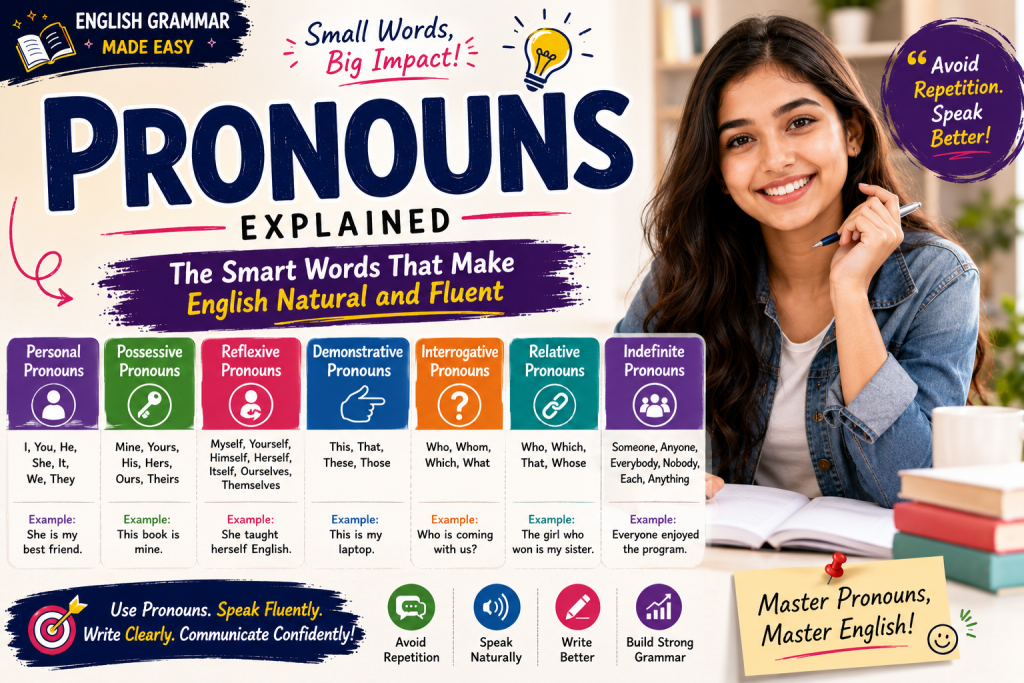
Types of Pronouns
English contains several kinds of pronouns. Each type has a different function.
1. Personal Pronouns
These refer to people, places, or things.
Subject Pronouns
- I
- You
- He
- She
- It
- We
- They
Examples
- She is reading.
- They are playing football.
Object Pronouns
- Me
- You
- Him
- Her
- It
- Us
- Them
Examples
- Ali called me.
- I saw them yesterday.
2. Possessive Pronouns
These show ownership.
Examples
- Mine
- Yours
- His
- Hers
- Ours
- Theirs
Sentences
- This book is mine.
- That house is theirs.
3. Demonstrative Pronouns
These point to specific things.
Examples
- This
- That
- These
- Those
Sentences
- This is my bag.
- Those are beautiful flowers.
4. Reflexive Pronouns
These refer back to the subject.
Examples
- Myself
- Yourself
- Himself
- Herself
- Themselves
Sentences
- She taught herself English.
- I made this cake myself.
5. Interrogative Pronouns
These are used to ask questions.
Examples
- Who
- Whom
- Which
- What
Sentences
- Who is your teacher?
- Which do you prefer?
6. Relative Pronouns
These connect clauses or provide more information.
Examples
- Who
- Which
- That
- Whose
Sentences
- The boy who won the race is my friend.
- This is the book that I bought.
7. Indefinite Pronouns
These refer to non-specific people or things.
Examples
- Someone
- Anyone
- Everybody
- Nobody
Sentences
- Someone is knocking at the door.
- Everybody enjoyed the party.
How Pronouns Improve Communication
Pronouns help conversations sound natural and fluent.
Imagine this dialogue without pronouns:
Hasan said Hasan would help Hasan’s brother because Hasan’s brother was sick.
Now with pronouns:
Hasan said he would help his brother because he was sick.
Much smoother.
This is why pronouns are essential in real communication.
Common Pronoun Mistakes
Many English learners make mistakes while using pronouns.
1. Subject vs Object Pronouns
Wrong:
Me went to school.
Correct:
I went to school.
“I” is a subject pronoun.
2. Confusing “Its” and “It’s”
Its
Shows possession.
The cat cleaned its paws.
It’s
Means “it is.”
It’s raining today.
This mistake is extremely common.
3. Using the Wrong Pronoun
Wrong:
Everyone should bring their book.
(Formally, this is debated.)
Traditional formal English:
Everyone should bring his or her book.
However, modern English often accepts “their” as gender-neutral.
Pronouns in Daily English Conversation
Pronouns appear constantly in spoken English.
At school
- She is my teacher.
- They are my classmates.
At home
- It is on the table.
- We are watching TV.
At work
- He sent me an email.
- They completed the project.
Learning pronouns well improves both fluency and confidence.
Tips to Master Pronouns
1. Read English Regularly
Books, articles, and dialogues help you observe natural pronoun usage.
Useful resources:
- BBC Learning English
- British Council English resources
2. Practise Speaking
Try describing people around you using pronouns.
Example:
My sister is a student. She studies every day.
3. Write Short Paragraphs
Daily writing practice helps strengthen grammar.
Example:
My parents are teachers. They work in different schools.
Takeaway
Pronouns are small words, but they play a huge role in English communication.
They help:
- Avoid repetition
- Improve fluency
- Make sentences natural
- Simplify communication
Without pronouns, English would sound repetitive and unnatural.
Mastering pronouns is an important step toward becoming a confident English speaker and writer.
Quick Quiz
1. Which sentence is correct?
2. Which pronoun shows possession?
3. Identify the pronoun:
They are studying English.
4. Which sentence is correct?
5. Identify the pronoun:
It was a good decision
Summary
In this lesson, you learned:
- What pronouns are
- Why pronouns are important
- Different types of pronouns
- Common pronoun mistakes
- Practical usage in daily conversation
Pronouns make English:
- More natural
- More fluent
- Easier to understand
The better you understand pronouns, the more confidently you can speak and write English.
So instead of repeating nouns again and again, use pronouns wisely and make your English smoother and smarter.