
Prepositions Explained: The Essential Words That Connect English Sentences Naturally
Lesson 22 of 29 (76%)
Introduction
Imagine someone says:
The book is the table.
The sentence sounds incomplete and confusing.
Now look at this:
The book is on the table.
The small word on makes the sentence meaningful. That connecting word is called a Preposition. There are major eight parts of speech in English grammar and preposition is one of them.
Prepositions are among the most important building blocks of English grammar. They help us describe:
- Place
- Time
- Direction
- Movement
- Relationships between words
Without prepositions, English sentences would sound broken and unnatural.
Whether you are speaking English in daily life, writing emails, preparing for exams, or improving fluency, learning prepositions is essential for clear communication.It is essential for basic English sentence structure
In this lesson, you will learn:
- What prepositions are
- Different types of prepositions
- How prepositions work in sentences
- Common learner mistakes
- Practical examples from real-life English
This complete guide is written in a professional BBC Learning English-style format to help beginners and intermediate learners master prepositions confidently.
Learning Objectives
By the end of this lesson, you will be able to:
- Understand what a preposition is
- Identify prepositions in sentences
- Learn different types of prepositions
- Use prepositions correctly in speaking and writing
- Avoid common preposition mistakes
What Is a Preposition?
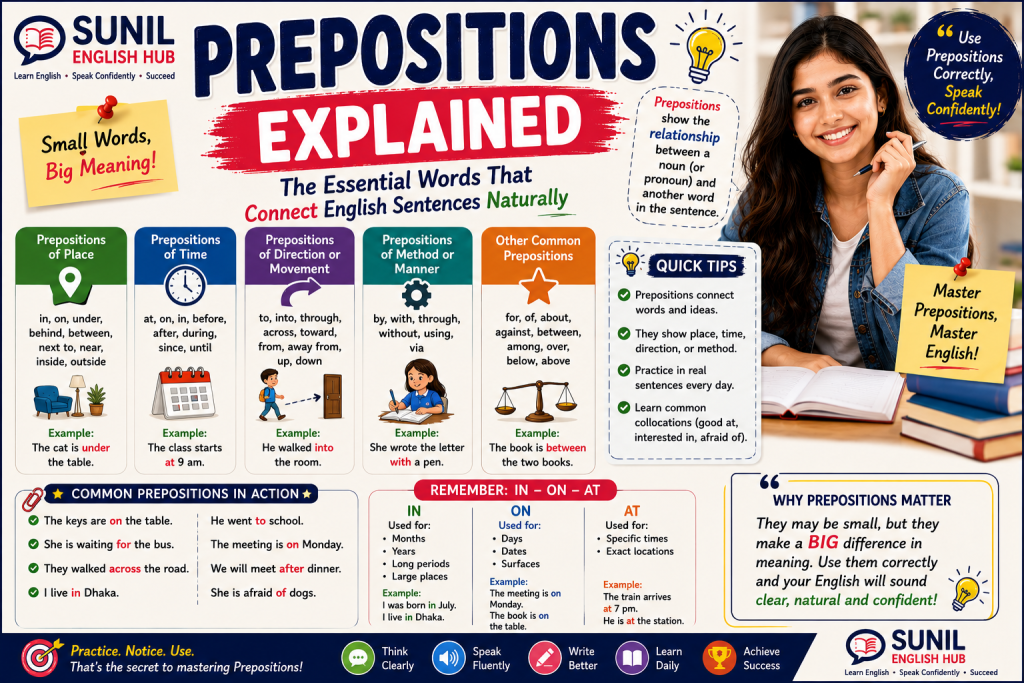
A preposition is a word that shows the relationship between a Noun (or Pronoun) and another word in the sentence.
Prepositions often describe:
- Position
- Direction
- Time
- Movement
- Method
Examples of Prepositions
- The cat is under the table.
- She arrived at school early.
- We walked through the park.
- The meeting starts at 10 am.
In these sentences, the prepositions connect ideas and provide important details.
Why Are Prepositions Important?
Prepositions make English:
- More accurate
- More natural
- More understandable
- More fluent
Compare these two sentences:
Without preposition:
She is sitting the chair.
With preposition:
She is sitting on the chair.
The second sentence is correct and clear.
Prepositions may be small words, but they carry huge meaning.
Types of Prepositions
English has several kinds of prepositions. Each type serves a different purpose.
1. Prepositions of Place
These describe where something is located.
Common Examples
- In
- On
- Under
- Behind
- Between
- Beside
- Near
Sentences
- The keys are on the table.
- The bag is under the bed.
- She lives near the market.
2. Prepositions of Time
These describe when something happens.
Common Examples
- At
- On
- In
- Before
- After
- During
Sentences
- The class starts at 9 am.
- I was born in July.
- We will meet after lunch.
3. Prepositions of Direction or Movement
These describe movement from one place to another.
Common Examples
- To
- Into
- Through
- Across
- Toward
Sentences
- He walked into the room.
- They travelled through the forest.
- She ran toward the gate.
4. Prepositions of Method or Manner
These describe how something happens.
Examples
- By
- With
- Through
Sentences
- He travelled by bus.
- She cut the paper with scissors.
Understanding “In,” “On,” and “At”
These three prepositions confuse many learners.
Using “In”
Used for:
- Months
- Years
- Large places
- Enclosed spaces
Examples
- I was born in 2005.
- She lives in Dhaka.
Using “On”
Used for:
- Days
- Dates
- Surfaces
Examples
- The meeting is on Monday.
- The phone is on the desk.
Using “At”
Used for:
- Specific times
- Exact locations
Examples
- The train arrives at 7 pm.
- He is waiting at the station.
Prepositions in Daily Conversation
Prepositions appear constantly in spoken English.
Talking about location
- I am at home.
- She is in the kitchen.
Talking about time
- We will leave after dinner.
- The movie starts at night.
Talking about movement
- He went to school.
- They walked across the road.
Mastering prepositions helps your English sound natural and fluent.
Common Preposition Mistakes
Many learners struggle with prepositions because English uses them differently from Bangla and other languages.
1. Incorrect Time Prepositions
Wrong:
I was born on 2001.
Correct:
I was born in 2001.
Years use “in.”
2. Missing Prepositions
Wrong:
She is waiting the bus.
Correct:
She is waiting for the bus.
Some verbs require specific prepositions.
3. Wrong Place Prepositions
Wrong:
He is in the bus stop.
Correct:
He is at the bus stop.
“At” is used for exact locations.
Prepositional Phrases
A preposition often works with a noun to form a phrase.
Examples
- In the morning
- At school
- On the table
- Under the chair
These phrases are extremely common in English.
Tips to Master Prepositions
1. Learn Through Context
Do not memorise random lists.
Learn prepositions through real sentences.
Example:
- interested in
- good at
- afraid of
2. Read English Every Day
Books, articles, and news reports help you notice natural preposition usage.
Useful resources:
- BBC Learning English
- British Council English resources
3. Practise Speaking
Use prepositions consciously in daily conversation.
Instead of:
I arrived school.
Say:
I arrived at school.
Small corrections make a big difference.
Takeaway
Prepositions are essential words that connect ideas and clarify meaning.
They help speakers describe:
- Time
- Place
- Direction
- Relationships
Without prepositions, English becomes unclear and unnatural.
Mastering prepositions is one of the most important steps toward fluent English communication.
Quick Quiz
1. Which sentence is correct?
2. Which preposition is used with years?
3. Identify the preposition in this sentence, “She walked through the park”
4.Fill in the blank with correct preposition
Try to complete task …time
He will have arrived….the station by 12:00pm
Summary
In this lesson, you learned:
- What prepositions are
- Different types of prepositions
- How prepositions work
- Common mistakes learners make
- Practical usage examples
Prepositions make English:
- More natural
- More accurate
- More fluent
- Easier to understand
The better you understand prepositions, the more confidently you can speak and write English.
So instead of saying:
“The book is the table.”
Say:
“The book is on the table.”
That small word changes everything.