
Mastering Clauses in English Grammar: The Building Blocks of Meaningful Sentences
Lesson 6 of 29 (21%)
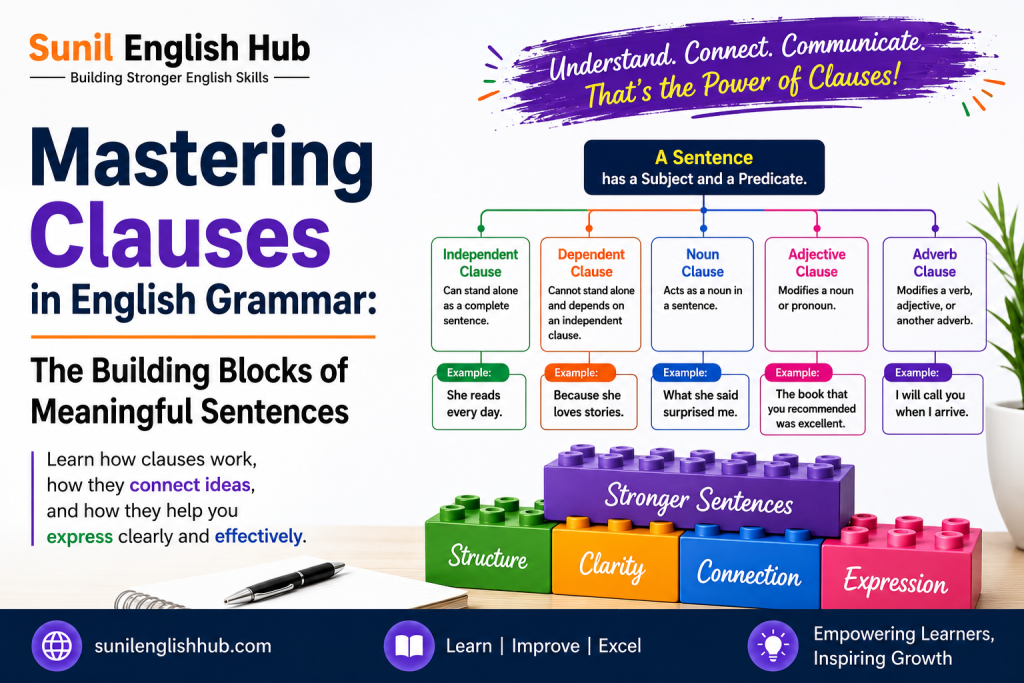
1. Definition of a Clause
A clause is a group of words that contains a subject and a predicate (Verb). It is a fundamental unit of sentence structure in English. Clauses help convey complete or partial ideas and are essential for forming meaningful communication.
2. Main Types of Clauses
2.1 Independent Clause
An independent clause (or main clause) expresses a complete thought and can stand alone as a sentence.
Example:
- She enjoys reading.
- They are playing football.
These clauses do not require additional information to be understood.
2.2 Dependent Clause
A dependent clause (or subordinate clause) does not express a complete thought and cannot stand alone. It must be connected to an independent clause.
Example:
- because she enjoys reading
- when they arrive
Combined Sentence:
- She goes to the library because she enjoys reading.
3. Types of Dependent Clauses
3.1 Noun Clause
A noun clause functions as a noun within a sentence. It can act as a subject, object, or complement.
Examples:
- What he said was surprising. (Subject)
- I know that he is honest. (Object)
3.2 Adjective Clause (Relative Clause)
An adjective clause modifies a noun or Pronoun and usually begins with relative pronouns such as who, which, that.
Example:
- The book that you gave me is fascinating.
3.3 Adverbial Clause
An adverbial clause modifies a verb, adjective, or Adverb. It provides information about time, place, reason, condition, contrast, or manner.
Examples:
- I will call you when I arrive. (Time)
- She stayed home because it was raining. (Reason)
4. Conjunctions Used with Clauses
4.1 Coordinating Conjunctions
These connect independent clauses. Common examples include: and, but, or, so, yet.
Example:
- She wanted to travel, but she stayed home.
4.2 Subordinating Conjunctions
These introduce dependent clauses and show relationships between ideas. Examples include: because, although, if, when, while.
Example:
- Although it was raining, they continued their journey.
5. Clauses and Sentence Types
Clauses help form different kinds of sentences:
- Simple Sentence: One independent clause
- She reads every day.
- Compound Sentence: Two independent clauses
- She reads books, and she writes stories.
- Complex Sentence: One independent + one dependent clause
- She reads books because she loves knowledge.
- Compound-Complex Sentence: At least two independent + one dependent clause
- She reads books, and she writes stories because she loves knowledge.
6. Importance of Clauses
Understanding clauses is essential because they:
- Improve sentence clarity
- Add variety and complexity
- Help express relationships between ideas
- Enhance both writing and speaking skills
7. Conclusion
Clauses are the building blocks of English sentences. By mastering independent and dependent clauses and their various types, learners can construct clear, precise, and sophisticated sentences. A strong command of clauses ultimately leads to more effective communication in both academic and everyday contexts.