
Adverbs Explained: The Powerful Words That Make Your English More Clear and Expressive
Lesson 21 of 29 (72%)
Introduction
Imagine someone says:
She speaks.
Now compare it with:
She speaks clearly.
Which sentence gives more information?
The second sentence is more meaningful because the word clearly explains how she speaks. That describing word is called an Adverb.
Adverbs are one of the most important parts of English grammar. They make sentences more detailed, expressive, and accurate. Native English speakers use adverbs constantly in conversations, writing, storytelling, news reports, and professional communication.
Whether you want to improve spoken English, writing skills, or exam performance, learning adverbs can make your English sound more natural and fluent.
In this lesson, you will learn:
- What adverbs are
- Different types of adverbs
- How adverbs work in sentences
- Common mistakes learners make
- Practical examples from daily English
This guide is written in a professional and learner-friendly style to help beginners and intermediate learners master adverbs confidently.
Learning Objectives
By the end of this lesson, you will be able to:
- Understand what an adverb is
- Identify adverbs in sentences
- Learn different types of adverbs
- Use adverbs correctly in speaking and writing
- Avoid common adverb-related mistakes
What Is an Adverb?
An adverb is a word that modifies:
Adverbs usually describe:
- How
- When
- Where
- How often
- To what extent something happens
Examples of Adverbs
- She sings beautifully.
- They arrived late.
- He runs quickly.
- I am very happy.
In these examples, the adverbs provide additional information.
Why Are Adverbs Important?
Adverbs help make communication:
- More specific
- More expressive
- More interesting
- More natural
Compare:
Without adverb:
He spoke.
With adverb:
He spoke confidently.
The second sentence gives a much clearer picture.
Adverbs improve both spoken and written English.
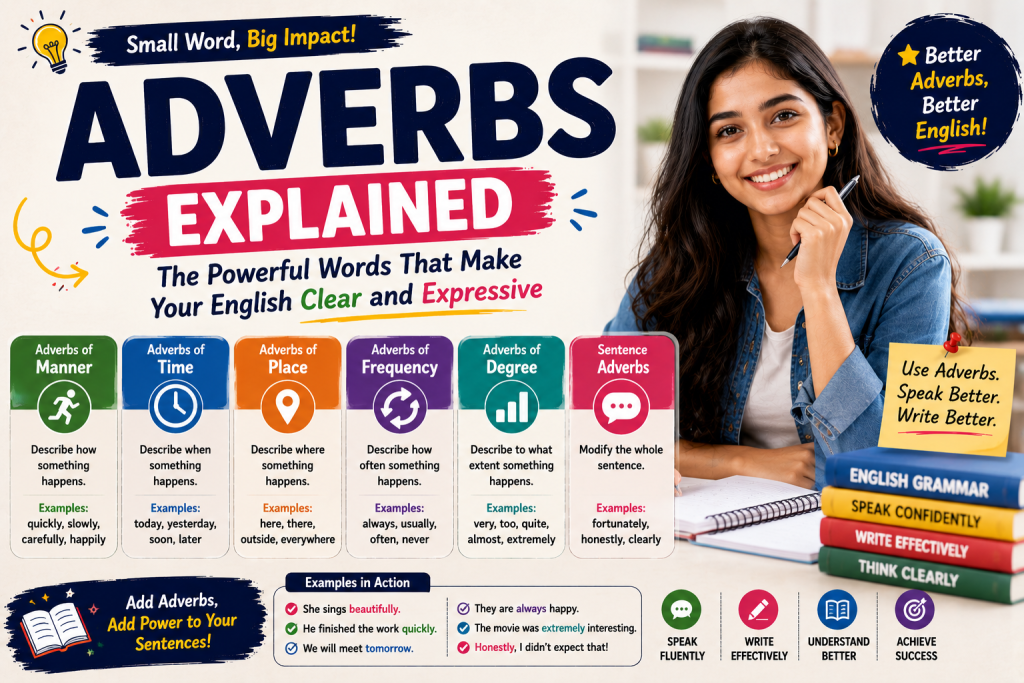
Types of Adverbs
English contains several kinds of adverbs. Each type has a different function.
1. Adverbs of Manner
These describe how something happens.
Examples
- Quickly
- Slowly
- Carefully
- Happily
Sentences
- She danced gracefully.
- He completed the work carefully.
Most adverbs of manner end in -ly.
2. Adverbs of Time
These describe when something happens.
Examples
- Today
- Yesterday
- Soon
- Later
Sentences
- We will leave tomorrow.
- She called me yesterday.
3. Adverbs of Place
These describe where something happens.
Examples
- Here
- There
- Everywhere
- Outside
Sentences
- Please sit here.
- The children are playing outside.
4. Adverbs of Frequency
These describe how often something happens.
Examples
- Always
- Usually
- Often
- Sometimes
- Never
Sentences
- I always drink tea in the morning.
- He rarely watches television.
These adverbs are extremely common in daily conversation.
5. Adverbs of Degree
These describe to what extent something happens.
Examples
- Very
- Too
- Quite
- Almost
- Extremely
Sentences
- She is very intelligent.
- The movie was extremely interesting.
Position of Adverbs in Sentences
Adverbs can appear in different positions depending on their type.
Adverbs of Frequency
Usually appear before the main verb.
Example
- She always studies at night.
But after the verb “to be.”
Example
- He is always punctual.
Adverbs of Manner
Usually appear after the verb or object.
Example
- They spoke politely.
- She completed the task quickly.
Adverbs of Time
Often appear at the beginning or end of a sentence.
Example
- Yesterday, I met my teacher.
- We will travel tomorrow.
How to Form Adverbs
Many adverbs are formed by adding -ly to adjectives.
Examples
| Adjective | Adverb |
|---|---|
| Quick | Quickly |
| Happy | Happily |
| Careful | Carefully |
| Slow | Slowly |
Important Exceptions
Some words do not follow the normal rule.
Examples
- Fast → Fast
- Hard → Hard
- Late → Late
Example Sentences
- He runs fast.
- She works hard.
Common Mistakes with Adverbs
Many learners confuse adjectives and adverbs.
1. Using an Adjective Instead of an Adverb
Wrong:
She sings beautiful.
Correct:
She sings beautifully.
“Beautifully” describes the verb “sings,” so we use an adverb.
2. Confusing “Hard” and “Hardly”
Hard
Means “with effort.”
He works hard.
Hardly
Means “almost not.”
I hardly know him.
These words have completely different meanings.
3. Double Adverbs
Wrong:
She spoke very loudlyly.
Correct:
She spoke very loudly.
Adverbs in Daily English Conversation
Adverbs appear everywhere in real-life communication.
Talking about habits
- I usually wake up early.
- She rarely eats fast food.
Talking about feelings
- He spoke confidently.
- They happily accepted the invitation.
Talking about time
- We will meet tomorrow.
- I recently visited Dhaka.
Learning adverbs helps your English sound natural and fluent.
Tips to Master Adverbs
1. Read English Regularly
Books, articles, and news reports show natural adverb usage.
Useful resources:
- BBC Learning English
- British Council English resources
2. Listen to Native Speakers
Watch interviews, documentaries, and English videos carefully.
Notice words like:
- usually
- probably
- clearly
- honestly
These are commonly used adverbs.
3. Practise Speaking
Try adding adverbs while speaking.
Instead of:
He answered.
Say:
He answered politely.
Small improvements make your English richer.
Takeaway
Adverbs are powerful words that improve clarity, fluency, and expression.
They help speakers explain:
- How something happens
- When it happens
- Where it happens
- How often it happens
Without adverbs, English sounds plain and incomplete.
Mastering adverbs is an important step toward speaking English naturally and confidently.
Quick Quiz
1. Which word is the adverb?
She speaks softly.
2. Which sentence is correct?
3. Which adverb shows frequency?
4. Which adverb shows time?
5. Which word is the adverb?
The pen writes well.
Summary
In this lesson, you learned:
- What adverbs are
- Different types of adverbs
- Adverb positions in sentences
- Common mistakes to avoid
- Practical daily usage examples
Adverbs make English:
- More expressive
- More accurate
- More natural
- More engaging
The better you understand adverbs, the more fluent and confident your English becomes.
So instead of saying:
“She answered.”
Try saying:
“She answered politely and confidently.”
That is the power of adverbs.