
Direct Speech and Indirect Speech: What’s the Difference?
Lesson 29 of 29 (100%)
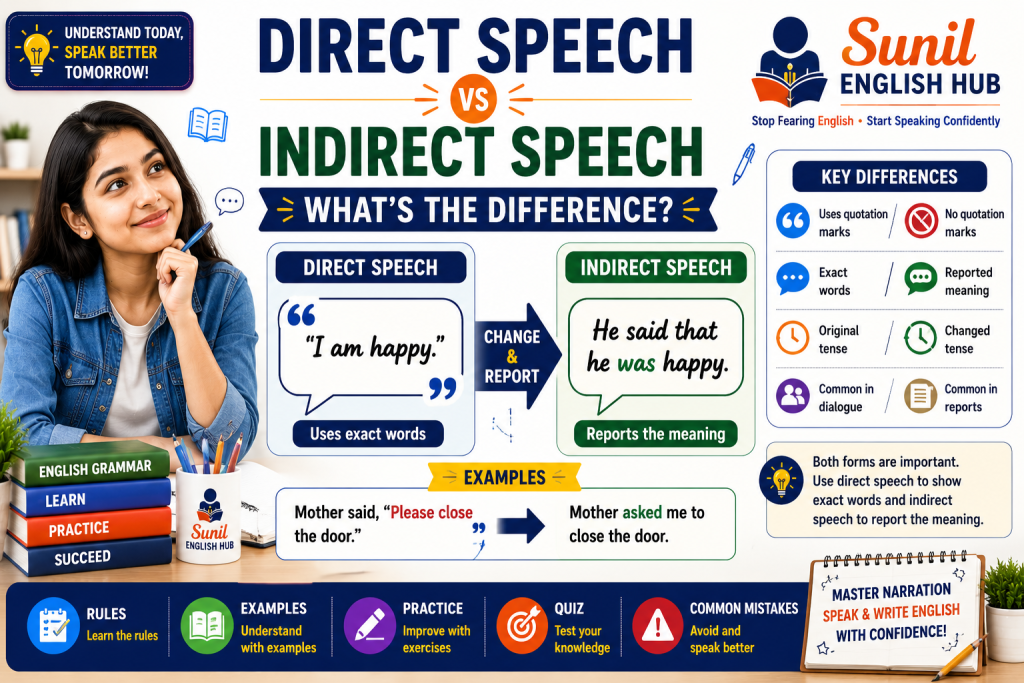
Direct Speech and Indirect Speech are two important ways of reporting what someone says. In English grammar, this topic is called Narration or Reported Speech. Direct speech repeats the exact words of a speaker, while indirect speech reports the meaning in our own words.
Many learners become confused because both forms can express the same message, but the sentence structure changes. For example, He said, “I am happy” and He said that he was happy have almost the same meaning, but they are written differently.
In this lesson, you will learn the difference between direct and indirect speech, how they are formed, when to use each one, common changes, examples, mistakes, quiz questions, and practical tips for using them correctly.
Learning Objectives
- Understand the meaning of direct speech and indirect speech.
- Identify the key differences between direct and indirect speech.
- Learn how quotation marks, pronouns, tenses, and reporting verbs change.
- Use direct and indirect speech correctly in writing and speaking.
- Avoid common mistakes in narration.
What Is Direct Speech?
Direct Speech means reporting the exact words spoken by a person. The speaker’s words are placed inside quotation marks.
Example:
Rina said, “I am reading a book.”
Here, the exact words spoken by Rina are: I am reading a book. These words are written inside quotation marks. Direct speech is common in stories, conversations, interviews, dialogues, and news reports where exact words are important.
What Is Indirect Speech?
Indirect Speech means reporting the meaning of someone’s words without using the exact words. It is also called reported speech.
Example:
Rina said that she was reading a book.
In this sentence, we are not quoting Rina’s exact words. We are reporting the meaning. Notice that quotation marks are removed, the Pronoun changes from I to she, and the tense changes from am reading to was reading.
For a complete foundation of this grammar topic, read Narration in English Grammar: Direct and Indirect Speech Explained.
Main Difference Between Direct Speech and Indirect Speech
| Direct Speech | Indirect Speech |
|---|---|
| Reports exact words | Reports meaning |
| Uses quotation marks | Does not use quotation marks |
| Pronouns usually remain unchanged | Pronouns often change |
| Tense may remain as spoken | Tense often changes when the reporting Verb is past |
| Common in dialogues and stories | Common in reports and summaries |
Parts of a Direct Speech Sentence
A direct speech sentence usually has two parts:
- Reporting Clause
- Reported Speech
Example:
He said, “I will help you.”
Reporting Clause: He said
Reported Speech: “I will help you.”
The reporting clause tells us who spoke. The reported speech tells us what the person said.
How Direct Speech Changes into Indirect Speech
When we change direct speech into indirect speech, several changes may happen. These changes depend on the reporting verb, pronouns, tense, sentence type, and time expressions.
1. Quotation Marks Are Removed
Direct: He said, “I am busy.”
Indirect: He said that he was busy.
In indirect speech, quotation marks are not used.
2. Pronouns Change
Pronouns change according to the speaker and listener.
Direct: She said, “I like my school.”
Indirect: She said that she liked her school.
Here, I becomes she, and my becomes her.
To understand pronouns better, read Pronouns Explained in English Grammar.
3. Tense Often Changes
If the reporting verb is in the past tense, the tense in the reported speech often moves one step back.
| Direct Speech | Indirect Speech |
|---|---|
| Present Simple | Past Simple |
| Present Continuous | Past Continuous |
| Present Perfect | Past Perfect |
| Past Simple | Past Perfect |
| Will | Would |
| Can | Could |
Direct: He said, “I work hard.”
Indirect: He said that he worked hard.
Tense is very important in narration. For better understanding, read Tense: ইংরেজি ভাষার প্রাণ and Present Simple Tense.
4. Time and Place Words Change
Some time and place expressions change in indirect speech.
| Direct Speech | Indirect Speech |
|---|---|
| now | then |
| today | that day |
| tomorrow | the next day |
| yesterday | the previous day |
| here | there |
| this | that |
Direct: He said, “I will come tomorrow.”
Indirect: He said that he would come the next day.
When Should You Use Direct Speech?
Use direct speech when the exact words are important.
- In dialogues
- In storytelling
- In interviews
- In quotations
- When you want to show emotion or personality
Example:
The teacher said, “Never stop learning.”
This direct speech sounds powerful because the exact words carry emotion.
When Should You Use Indirect Speech?
Use indirect speech when the meaning is more important than the exact words.
- In summaries
- In reports
- In academic writing
- In formal communication
- When you do not need the speaker’s exact words
Example:
The teacher advised us never to stop learning.
This sounds smoother and more formal.
Direct and Indirect Speech Examples
| Direct Speech | Indirect Speech |
|---|---|
| He said, “I am tired.” | He said that he was tired. |
| She said, “I have finished my homework.” | She said that she had finished her homework. |
| They said, “We are playing football.” | They said that they were playing football. |
| He said, “I can swim.” | He said that he could swim. |
| Mother said, “Dinner is ready.” | Mother said that dinner was ready. |
Important Exception: Universal Truths
When the reported sentence expresses a universal truth, scientific fact, or permanent truth, the tense usually does not change.
Direct: The teacher said, “The earth moves around the sun.”
Indirect: The teacher said that the earth moves around the sun.
The sentence is a scientific fact, so the tense remains the same.
Common Mistakes Learners Make
1. Keeping Quotation Marks in Indirect Speech
Wrong: He said that “he was busy.”
Correct: He said that he was busy.
2. Forgetting Pronoun Changes
Wrong: Rina said that I was happy.
Correct: Rina said that she was happy.
3. Using Said Instead of Asked for Questions
Wrong: He said me where I lived.
Correct: He asked me where I lived.
4. Forgetting Tense Changes
Wrong: He said that he is ready.
Correct: He said that he was ready.
For more common errors, read Common Spoken English Mistakes.
Direct and Indirect Speech in Spoken English
In daily conversation, both direct and indirect speech are useful. Direct speech makes conversation lively, while indirect speech helps us report information smoothly.
Direct: My friend said, “Let’s go outside.”
Indirect: My friend suggested that we go outside.
To improve speaking naturally, read Speak with Confidence: Mastering Basic English Conversation.
Direct and Indirect Speech in IELTS and Academic English
Indirect speech is useful in IELTS Writing and academic English when reporting opinions, research findings, or statements. It helps make writing formal and organized.
Example:
The researcher stated that regular practice improved language confidence.
If you are preparing for IELTS, read What Is IELTS? Everything Beginners Need to Know and IELTS Speaking Part 1.
You can also learn more from trusted external resources such as British Council Grammar and BBC Learning English.
Tips to Master Direct and Indirect Speech
- First identify the reporting clause and reported speech.
- Check whether the reporting verb is in the past tense.
- Change pronouns according to the speaker and listener.
- Learn common tense changes.
- Remove quotation marks in indirect speech.
- Use correct reporting verbs such as said, told, asked, advised, and ordered.
- Practise with different sentence types regularly.
Takeaway
Direct speech and indirect speech are two ways of reporting someone’s words. Direct speech repeats the exact words and uses quotation marks. Indirect speech reports the meaning and usually changes pronouns, tense, reporting verbs, and time expressions. Both are important, but they are used in different situations.
If you want your writing to sound lively, direct speech is useful. If you want your writing to sound smooth, formal, and organized, indirect speech is often better.
Quiz: Test Your Understanding
1. Which speech reports exact words?
2. Which sentence is in indirect speech?
3. What usually happens to quotation marks in indirect speech?
4. What does “will” usually become in indirect speech?
5. Which reporting verb is usually used for questions?
📖 Show Answer Key
Answer Key
- Direct Speech
- He said that he was busy.
- They are removed
- Would
- Asked
Summary
In this lesson, you learned that direct speech reports the exact words of a speaker, while indirect speech reports the meaning. Direct speech uses quotation marks, but indirect speech does not. In indirect speech, pronouns, tenses, reporting verbs, and time expressions may change depending on the context.
You also learned when to use direct speech, when to use indirect speech, common mistakes, practical examples, and useful tips. Mastering this difference will help you write better, speak more clearly, and understand English grammar more confidently.
Related Lessons
- Narration in English Grammar: Direct and Indirect Speech Explained
- What Is a Verb? The Engine of a Sentence
- Pronouns Explained in English Grammar
- Basic English Sentence Structure
- Tense: ইংরেজি ভাষার প্রাণ
- Present Simple Tense
- Common Spoken English Mistakes
- Speak with Confidence: Mastering Basic English Conversation