
Present Simple Tense: Easy Rules, Examples & Practice for Beginners
Lesson 12 of 29 (41%)
Introduction
Do you want to speak English confidently but feel confused about tenses?
You are not alone. Many learners struggle with English because they do not clearly understand how tenses work—especially the Present Simple tense.
The truth is simple: Present Simple is the most important tense in English.
We use it every day to talk about routines, habits, facts, and general truths. If you can master this tense, you will be able to express many of your daily thoughts clearly and confidently.
In this article, you will learn the Present Simple Tense in a clear, practical, and easy-to-understand way, with rules, examples, tips, and exercises.
Learning Objectives
By the end of this article, you will be able to:
- Understand what Present Simple Tense is
- Use correct sentence structures
- Form positive, negative, and question sentences
- Identify and correct common mistakes
- Speak English more confidently in daily situations
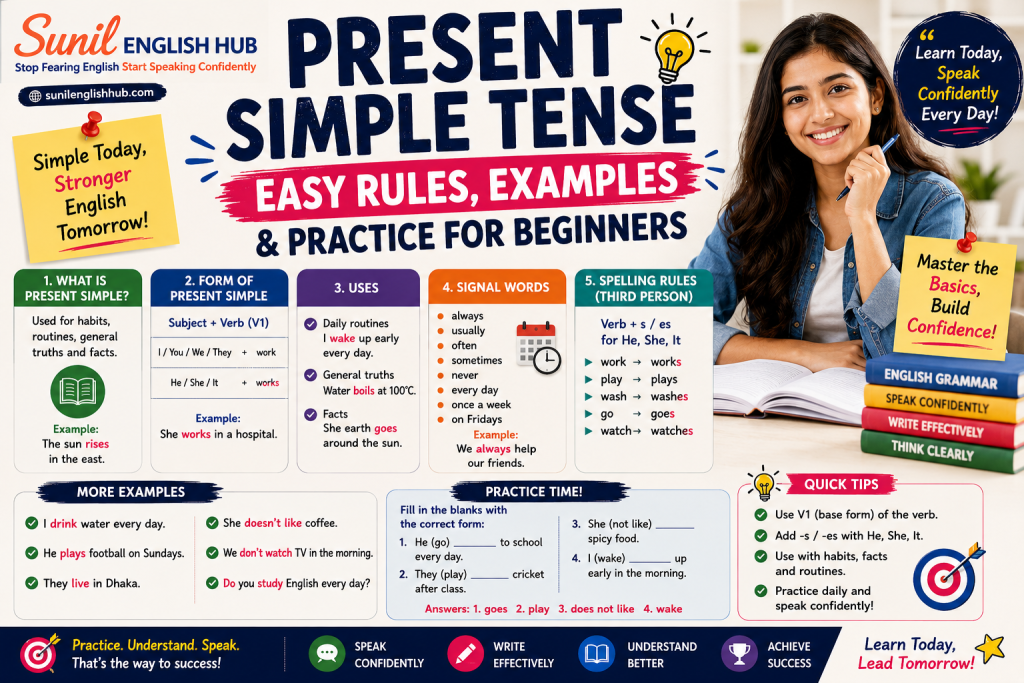
What Is Present Simple Tense?
The Present Simple Tense is used to describe:
- Daily routines
- Habits
- General truths
- Permanent situations
Examples:
- I eat rice every day.
- She goes to school.
- The sun rises in the east.
These sentences describe actions that happen regularly or facts that are always true.
Basic Structure of Present Simple Tense
👉 Subject + Base Verb (+ s/es for he/she/it)
1. For I / You / We / They
👉 Structure:
Subject + Base Verb
Examples:
- I work in an office.
- They play football.
2. For He / She / It
👉 Structure:
Subject + Verb + s/es
Examples:
- He works in an office.
- She plays football.
👉 Rule: Add “s” or “es” to the verb when the subject is he, she, or it.
Types of Sentences
1. Positive Sentences
👉 Structure:
Subject + Verb (+ s/es)
Examples:
- I read books.
- She reads books.
2. Negative Sentences
👉 Structure:
Subject + do/does + not + base verb
Examples:
- I do not (don’t) read books.
- She does not (doesn’t) read books.
3. Interrogative (Question) Sentences
👉 Structure:
Do/Does + Subject + Base Verb?
Examples:
- Do you play football?
- Does he play football?
When to Use Present Simple Tense
1. Daily Routine
Use it to describe everyday activities.
Examples:
- I wake up at 6 am.
- I go to work every day.
2. Habits
Use it for repeated actions.
Examples:
- I drink tea every morning.
- She watches TV at night.
3. General Truths
Use it for facts that are always true.
Examples:
- Water boils at 100°C.
- The earth revolves around the sun.
4. Permanent Situations
Use it for stable conditions.
Examples:
- He lives in Dhaka.
- I work in an NGO.
Examples in Real Life
Example 1: Daily Life
- I wake up early.
- I brush my teeth.
- I go to work.
Example 2: Workplace
- I manage projects.
- She writes reports.
Example 3: Conversation
- Do you like coffee?
- Yes, I like coffee.
Common Mistakes (Very Important)
❌ Wrong:
He go to school.
✅ Correct:
He goes to school.
👉 Reason: Add “s” for he/she/it.
❌ Wrong:
She don’t like tea.
✅ Correct:
She doesn’t like tea.
❌ Wrong:
Does he goes to school?
✅ Correct:
Does he go to school?
👉 Rule: After “does,” use the base form of the verb.
Tips to Improve Your Use of Present Simple
1. Practice Daily
Create at least 5–10 sentences every day.
Example:
- I drink tea.
- I read books.
2. Focus on Patterns
Learn patterns like:
- Subject + Verb
- Subject + does not + Verb
3. Think in English
Avoid translating from your native language.
Instead, think directly:
- “I am tired today.”
- “She likes tea.”
4. Use Real-Life Situations
Practice using your own daily activities.
5. Speak Without Fear
Do not worry about mistakes. Practice builds confidence.
Practice Section
Correct the following sentences:
👉 He go to office
✔ He goes to office
👉 She don’t eat rice
✔ She doesn’t eat rice
👉 Do he play cricket?
✔ Does he play cricket?
Takeaway
- Present Simple Tense is used in everyday English
- Structure: Subject + Verb (+ s/es)
- Add “s/es” for he/she/it
- Practice regularly to improve
- Focus on communication, not perfection
👉 Simple tense = Strong foundation
Quiz (Test Your Understanding)
1. When do we use Present Simple Tense?
a) Past events
b) Future plans
c) Daily routines
d) Imaginary events
2. Which sentence is correct?
a) He go to school
b) He goes to school
3. What is the correct negative form?
a) He not go
b) He does not go
Answers:
- c
- b
- b
Summary
The Present Simple Tense is one of the most important parts of English grammar.
- It is used for routines, habits, and facts
- It has a simple structure: Subject + Verb
- “s/es” is added for he/she/it
- Practice helps you gain confidence
If you want to improve your English speaking, start with this tense and use it every day.
👉 Start today. Speak simple English. Improve step by step.
FAQ
Q1: What is Present Simple Tense?
It is a tense used to describe habits, routines, and general truths.
Q2: When do we add “s/es” to verbs?
We add “s/es” when the subject is he, she, or it.
Q3: How can I learn it quickly?
Practice daily, use real-life examples, and speak regularly.