
Nouns: The Building Blocks of Language
Lesson 3 of 29 (10%)
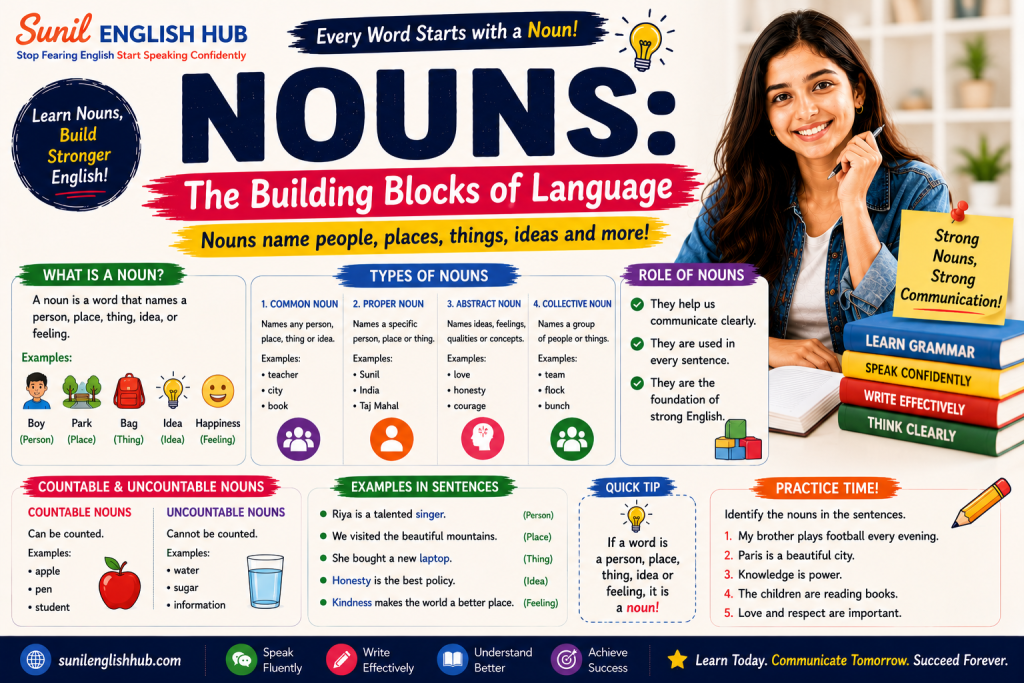
Language is like a house, and nouns are the bricks that make it strong and meaningful. Without nouns, sentences would collapse, and communication would feel incomplete. But what exactly is a Noun, and why is it so important? Let’s break it down in simple words so that school children, college students, and even curious adults can understand.
What is a Noun?
A noun is a word that names a person, place, thing, or idea. Think of it as a label we give to everything around us. For example:
Person: teacher, doctor, Sunil
Place: school, park, Bangladesh
Thing: book, chair, computer
Idea: happiness, freedom, love
Whenever you point at something and ask, “What is that?” the answer is usually a noun.
Types of Nouns
Nouns come in different forms, and knowing them makes writing and speaking clearer.
- Proper Nouns – Specific names.
Example: Jessore, Microsoft, Harry Potter
(Always start with a capital letter!) - Common Nouns – General names.
Example: city, company, book - Concrete Nouns – Things you can touch or see.
Example: apple, dog, car - Abstract Nouns – Feelings or ideas you cannot touch.
Example: joy, honesty, knowledge - Collective Nouns – Words for groups.
Example: team, family, floc
Why Are Nouns Important?
Imagine trying to talk without nouns. Instead of saying, “The cat is sleeping on the sofa,” you’d have to say something like, “That furry thing is resting on that soft thing.” Confusing, right? Nouns give clarity and make communication smooth.
Examples in Everyday Life
At school: Teacher, student, classroom
At home: Mother, kitchen, bed
Online: Computer, internet, message
Every sentence you speak or write probably has at least one noun. Try spotting them—it’s like a fun word game!
Quick Tips to Remember
If it names something, it’s a noun. Proper nouns always begin with capital letters. Abstract nouns are invisible but powerful—they express emotions and ideas. Collective nouns make groups sound neat and organized.
Conclusion
A noun is more than just a word—it’s the foundation of language. Whether you’re writing an essay, chatting with friends, or reading a story, nouns are everywhere, quietly holding sentences together. Mastering nouns is the first step to mastering English, and once you do, the rest of grammar becomes much easier.
So next time you speak or write, pause for a moment and notice the nouns around you. They’re the unsung heroes of communication!