
Time in Words: Mastering Tense for Clear and Powerful Communication
Lesson 8 of 29 (28%)
1. Introduction
tense is one of the most fundamental aspects of English grammar. It refers to the form of a Verb that indicates the time of an action or event. By using tense correctly, speakers and writers can clearly express whether something happens in the present, happened in the past, or will happen in the future. A strong understanding of tense is essential for accurate and effective communication.
2. Main Types of Tense
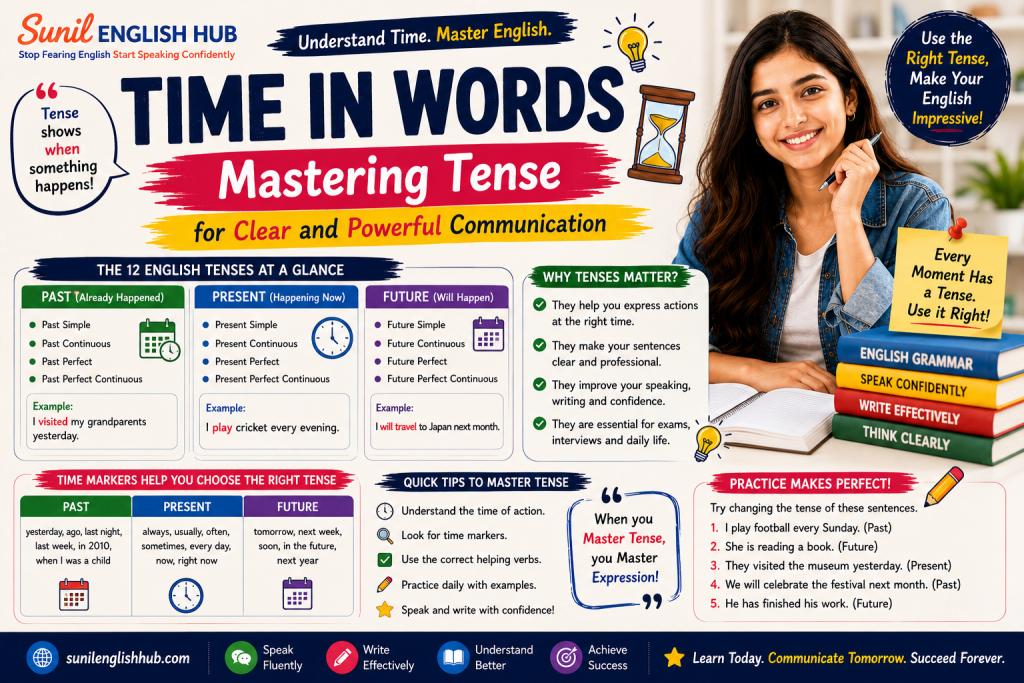
English tenses are broadly divided into three main categories:
2.1 Present Tense
The present tense describes actions that are happening now, habitual actions, or general truths.
Examples:
- She writes every day. (habit)
- The sun rises in the east. (general truth)
- I am reading a book. (action happening now)
2.2 past tense
The past tense describes actions that have already happened.
Examples:
- She wrote a letter yesterday.
- They visited the museum last week.
2.3 future tense
The future tense describes actions that will happen later.
Examples:
- She will write a letter tomorrow.
- They are going to travel next month.
3. The Four Aspects of Each Tense
Each of the three main tenses has four aspects, making a total of twelve tense forms.
3.1 Simple Tense
The simple tense expresses general actions without focusing on duration or completion.
- Present Simple: She plays.
- Past Simple: She played.
- Future Simple: She will play.
3.2 Continuous (Progressive) Tense
The continuous tense describes actions that are ongoing at a specific time.
- Present Continuous: She is playing.
- Past Continuous: She was playing.
- Future Continuous: She will be playing.
3.3 Perfect Tense
The perfect tense indicates completed actions or actions that have a connection to another time.
- Present Perfect: She has played.
- Past Perfect: She had played.
- Future Perfect: She will have played.
3.4 Perfect Continuous Tense
The perfect continuous tense emphasizes the duration of an action that started in the past and may continue.
- Present Perfect Continuous: She has been playing.
- Past Perfect Continuous: She had been playing.
- Future Perfect Continuous: She will have been playing.
4. Structure of Tense
Tense is formed using different verb forms and auxiliary (helping) verbs such as be, have, and do.
Examples:
- She is reading. (be verb for continuous)
- She has finished her work. (have verb for perfect)
- Do you like coffee? (do used in questions)
Understanding these structures helps learners form correct sentences in different contexts.
5. Uses of Tense in Communication
Tense helps express not only time but also the relationship between actions. For example:
- “I finished my work before he arrived.” (sequence of events)
- “She has lived here for ten years.” (connection between past and present)
Proper use of tense ensures clarity and avoids confusion in both spoken and written communication.
6. Common Errors in Tense Usage
- Mixing Tenses Incorrectly: Switching tenses without reason can confuse the reader.
- Incorrect Verb Forms: Using the wrong form of a verb leads to grammatical errors.
- Overuse of Simple Tense: Not using appropriate aspects can make expression less precise.
7. Importance of Learning Tense
Mastering tense allows learners to:
- Express time clearly
- Show relationships between actions
- Improve writing and speaking accuracy
- Communicate ideas more effectively
8. Conclusion
Tense is the backbone of English grammar that connects language with time. By understanding its types, aspects, and structures, learners can communicate more clearly and confidently. Whether writing an academic essay or engaging in everyday conversation, a solid grasp of tense ensures that ideas are conveyed accurately and effectively.