
Active Voice and Passive Voice: Understanding the Difference with Easy Examples
Lesson 27 of 29 (93%)
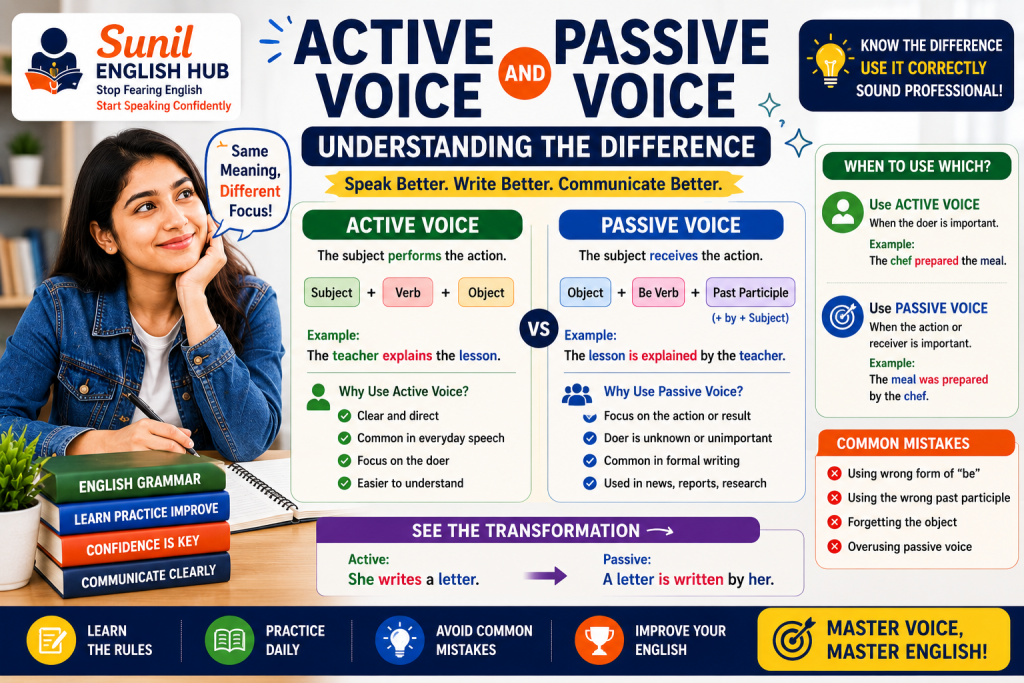
Active Voice and Passive Voice are two important ways of expressing an action in English. Both are grammatically correct, but they are used for different purposes. Active voice focuses on the person or thing that does the action, while passive voice focuses on the person or thing that receives the action.
Many learners become confused because the meaning of the sentence often remains similar, but the sentence structure changes. For example, “The teacher explains the lesson” and “The lesson is explained by the teacher” express almost the same idea, but the focus is different.
In this lesson, you will learn the difference between active and passive voice, their structures, uses, examples, common mistakes, and practical tips to use them correctly in speaking and writing.
Learning Objectives
- Understand the meaning of active voice and passive voice.
- Identify the difference between active and passive sentences.
- Learn the structure of active and passive voice.
- Understand when to use active voice and when to use passive voice.
- Avoid common mistakes in voice change.
What Is Active Voice?
In active voice, the subject of the sentence performs the action. The sentence is usually direct, clear, and strong.
Structure:
Subject + Verb + Object
Example:
The boy kicks the ball.
Here, the boy is the subject. He performs the action. The action is kicks. The object is the ball.
Active voice is the most common form in daily conversation because it sounds natural and simple. To understand this structure better, read Basic English Sentence Structure.
What Is Passive Voice?
In passive voice, the subject receives the action. The focus moves from the doer to the receiver of the action.
Structure:
Object + be verb + past participle + by + subject
Example:
The ball is kicked by the boy.
Here, the ball receives the action. The doer is the boy. The verb changes into the passive form: is kicked.
Passive voice is especially useful when the action is more important than the person who does it.
Main Difference Between Active Voice and Passive Voice
| Active Voice | Passive Voice |
|---|---|
| The subject does the action. | The subject receives the action. |
| It is direct and clear. | It is more formal or result-focused. |
| The doer is important. | The action or receiver is important. |
| Example: She writes a letter. | Example: A letter is written by her. |
Examples of Active and Passive Voice
| Active Voice | Passive Voice |
|---|---|
| Mother cooks rice. | Rice is cooked by mother. |
| They play football. | Football is played by them. |
| The police arrested the thief. | The thief was arrested by the police. |
| He will complete the work. | The work will be completed by him. |
| People speak English worldwide. | English is spoken worldwide. |
Notice that in passive voice, the object of the active sentence becomes the subject of the passive sentence.
How to Change Active Voice into Passive Voice
To change an active sentence into passive voice, follow these steps:
- Find the subject, verb, and object in the active sentence.
- Move the object to the beginning of the passive sentence.
- Use the correct form of the verb “be”.
- Use the past participle form of the main verb.
- Add “by” before the doer if necessary.
Active: The teacher teaches English.
Passive: English is taught by the teacher.
Voice is closely connected with verbs. If you need to revise verbs, read What Is a Verb? The Engine of a Sentence.
Active and Passive Voice in Different Tenses
Passive voice changes according to tense. Therefore, tense knowledge is very important. You can strengthen your tense foundation through Tense: ইংরেজি ভাষার প্রাণ.
Present Simple Tense
Active: She writes a story.
Passive: A story is written by her.
Formula: Object + am/is/are + past participle + by + subject
For more examples, read Present Simple Tense.
Past Simple Tense
Active: He opened the door.
Passive: The door was opened by him.
Formula: Object + was/were + past participle + by + subject
Future Simple Tense
Active: They will finish the project.
Passive: The project will be finished by them.
Formula: Object + will be + past participle + by + subject
Present Continuous Tense
Active: The students are reading the book.
Passive: The book is being read by the students.
Formula: Object + am/is/are being + past participle + by + subject
present perfect tense
Active: He has completed the task.
Passive: The task has been completed by him.
Formula: Object + has/have been + past participle + by + subject
When Should You Use Active Voice?
Use active voice when you want your sentence to be direct, simple, and strong.
Example:
The manager approved the plan.
This sentence is clear because we know who approved the plan. Active voice is useful in:
- Daily conversation
- Storytelling
- Instructions
- Personal writing
- Simple explanations
For spoken English, active voice is usually more natural. You can improve your speaking with Speak with Confidence: Mastering Basic English Conversation.
When Should You Use Passive Voice?
Use passive voice when the action or result is more important than the doer.
Example:
The road was repaired last week.
Here, the important point is that the road was repaired. The doer is not very important.
Passive voice is commonly used in:
- News reports
- Academic writing
- Scientific writing
- Official documents
- Formal reports
For more grammar practice, you may visit British Council Grammar and BBC Learning English.
Important Point: Not Every Sentence Can Be Passive
A sentence usually needs an object to become passive.
Example:
He sleeps.
This sentence has no object. So, it cannot normally be changed into passive voice.
But this sentence can be changed:
Active: He reads a book.
Passive: A book is read by him.
The reason is simple: a book is the object.
Common Mistakes in Active and Passive Voice
1. Forgetting the Past Participle
Wrong: The work is complete by him.
Correct: The work is completed by him.
2. Using the Wrong Be Verb
Wrong: The books is read by students.
Correct: The books are read by students.
3. Changing Tense Incorrectly
Wrong: The door is opened by him. (for past action)
Correct: The door was opened by him.
4. Overusing Passive Voice
Too much passive voice can make your writing weak and heavy. Use passive voice only when it is needed.
Active or Passive: Which One Is Better?
There is no single answer. It depends on your purpose.
If you want to focus on the doer, use active voice:
The doctor treated the patient.
If you want to focus on the receiver or result, use passive voice:
The patient was treated successfully.
In most daily communication, active voice is better. In formal writing, passive voice is often useful.
Active and Passive Voice in IELTS and Academic English
IELTS learners should understand both active and passive voice. Passive voice is useful in IELTS Writing Task 1, reports, process descriptions, and academic writing.
Example:
The data was collected from 200 students.
This sentence sounds formal and objective. If you are preparing for IELTS, start with What Is IELTS? Everything Beginners Need to Know and IELTS Speaking Part 1.
Tips to Master Active and Passive Voice
- First identify the subject, verb, and object.
- Learn the past participle form of common verbs.
- Practise tense-wise voice change.
- Use active voice for clear daily communication.
- Use passive voice when the action or result is more important.
- Read English articles and notice how voice is used naturally.
Takeaway
Active voice and passive voice are two useful ways of expressing action in English. Active voice focuses on the doer of the action, while passive voice focuses on the receiver or result of the action. Active voice is usually clearer and more natural in conversation, while passive voice is useful in formal, academic, and result-focused writing.
To master voice, you need to understand sentence structure, verb forms, tense, and past participles. With regular practice, active and passive voice will become much easier.
Quiz: Test Your Understanding
1. In active voice, the subject usually:
2. Which sentence is in passive voice?
3. What is the passive form of “They will complete the project”?
4. Which form of the main verb is used in passive voice?
5. Which sentence cannot normally be changed into passive voice?
📖 Show Answer Key
Answer Key
- Performs the action
- A song is sung by the girl.
- The project will be completed by them.
- Past participle form
- The baby sleeps.
Summary
In this lesson, you learned the difference between active voice and passive voice. In active voice, the subject performs the action. In passive voice, the subject receives the action. Active voice follows the structure Subject + Verb + Object, while passive voice follows Object + be verb + past participle + by + subject.
You also learned when to use active voice, when to use passive voice, how tense affects passive voice, and what common mistakes learners should avoid. Remember, active voice is usually best for clear communication, while passive voice is useful when the action, result, or receiver is more important than the doer.