
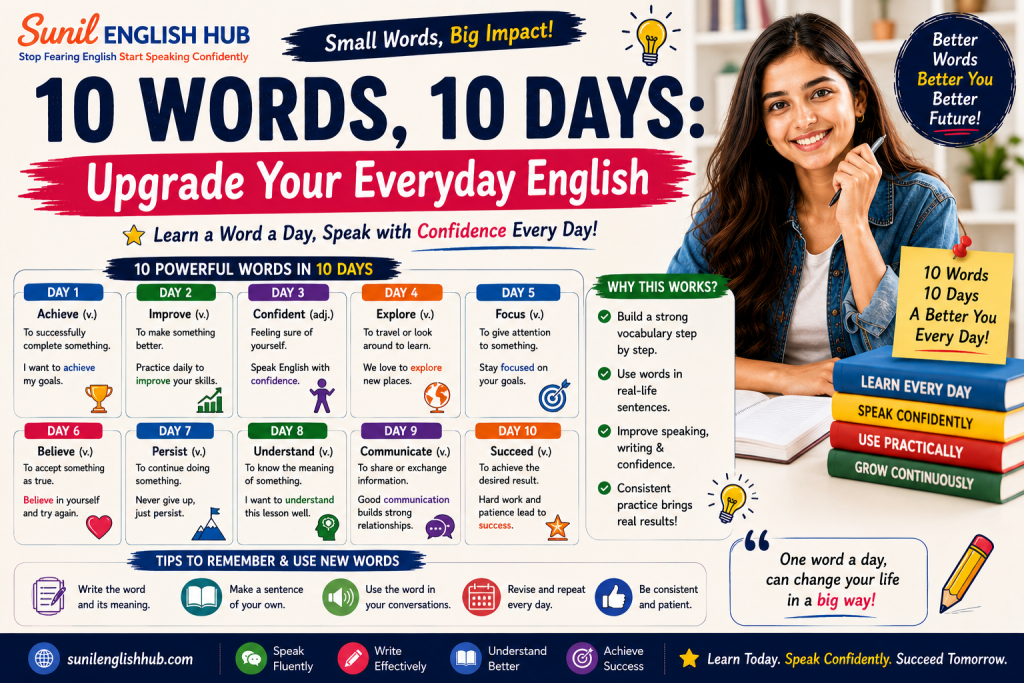
10 Words, 10 Days: Upgrade Your Everyday English
Lesson 5 of 29 (17%)
Day 1: The Word is ESSENTIAL
Title: Don’t Just Say “Important” – Master “Essential”
Welcome to our 10-day journey to mastering daily-use English! We’re starting strong with a word that is, well, essential.
What does it mean?
“Essential” means absolutely necessary; extremely important. If something is essential, you cannot do without it.
How to use it:
For things you need: “Water is essential for life.” “A good night’s sleep is essential for your health.”
For parts of something: “Grammar is an essential part of learning a language.” “Patience is an essential quality for a teacher.”
Common Patterns:
It is essential + to + Verb: “It is essential to arrive on time for the interview.”
It is essential + that + subject + verb: “It is essential that you bring your passport.”
Your Turn:
Think of one thing that is essential for your job or studies. Write a sentence using the word “essential.” For example: For me, a reliable internet connection is essential.
Click to learn verb: What is a Verb? The Engine of a Sentence
Day 2: The Word is FLEXIBLE
Title: Be Flexible: The One Word for Adaptability
Yesterday we talked about what’s essential. Today, we’ll look at a quality that helps us handle change. Welcome to day 2: Flexible.
What does it mean?
“Flexible” means able to change or be changed easily to suit a new situation. It’s the opposite of rigid or stiff.
How to use it:
For people and plans: “My work hours are very flexible.” “We need to be flexible when traveling.”
For objects: “This yoga mat is made of flexible material.” (It can bend easily).
Common Patterns:
Flexible + about + Noun: “She is very flexible about deadlines.”
Flexible enough to: “He isn’t flexible enough to work on weekends.”
A Quick Tip:
The noun form is flexibility. You can say, “The manager appreciates flexibility in the team.”
Your Turn:
Are you a flexible person? Think about a time you had to change your plans. Write: I had to be flexible when ________________. (e.g., …when the meeting was moved to a different day.)
Day 3: The Word is APPROACH
Title: Change Your Approach: A Word for Methods and Ideas
So far we’ve learned about things we need and how to adapt. Today, we’ll learn a powerful word for how we handle situations: Approach.
What does it mean?
As a noun, “approach” means a way of dealing with something or a method. As a verb, it means to come near or to speak to someone about something.
How to use it (Noun):
“We need a new approach to teaching English.”
“Her approach to problem-solving is very creative.”
How to use it (Verb):
“The final exam is approaching. I need to study.” (Getting closer in time)
“I was nervous to approach my boss with the idea.” (To speak to someone)
Common Patterns:
Approach + to + noun: “What is your approach to learning new vocabulary?”
Approach + someone + about + something: “I decided to approach my teacher about the assignment.”
Your Turn:
What is your approach to learning English? Write: My approach to learning English is to ________________.
Day 4: The Word is EFFECTIVE
Title: Stop Saying “Good” – Say “Effective”
Welcome to day 4. Today’s word is all about results. It’s not enough to just do something; we want to know if it works. Let’s learn the word Effective.
What does it mean?
“Effective” means successful in achieving a desired result. If something is effective, it works well.
How to use it:
For methods and medicines: “This new study method is very effective.” “Is this medicine effective against the flu?”
For people: “She is an effective leader.” (She gets good results).
For rules/laws: “The new law became effective on January 1st.” (In this context, it means “in operation”).
Important Note: Don’t confuse “effective” with “efficient.”
Effective = does the job. (It works)
Efficient = does the job in the best possible way without wasting time or energy.
Your Turn:
Think of one effective way to remember new words. Write: One effective way to remember vocabulary is to ________________.
Day 5: The Word is ENCOURAGE
Title: The Power of “Encourage”: More Than Just a Compliment
Halfway there! Today’s word is about motivation and support. It’s a verb that creates positivity: Encourage.
What does it mean?
“Encourage” means to give someone support, confidence, or hope. It’s the opposite of discourage.
How to use it:
To give support: “My parents always encourage me to follow my dreams.”
To make something more likely: “Lower prices encourage people to buy more.”
Common Patterns:
Encourage + someone + to + verb: “A good teacher encourages students to ask questions.”
Encourage + noun: “We want to encourage creativity in the classroom.”
A Quick Tip:
The noun form is encouragement. A kind word can be a great source of encouragement.
Your Turn:
Who encourages you? Or, who do you encourage? Write: I always encourage my friend/student/colleague to ________________.
Day 6: The Word is CONVENIENT
Title: Make Life Easier: The Meaning of “Convenient”
In our busy world, we all appreciate things that are easy and save us time. That’s the perfect description of today’s word: Convenient.
What does it mean?
“Convenient” means fitting in well with a person’s needs, activities, and plans; easy to use; suitable.
How to use it:
For time: “Is 3:00 PM a convenient time for the meeting?”
For places: “I live close to the station. It’s very convenient.”
For things: “Online shopping is so convenient. I can do it from my couch.”
Opposite:
The opposite is inconvenient. “It’s very inconvenient that the store closes so early.”
Your Turn:
What is one convenient thing about your city or town? Write: It’s very convenient that ________________. (e.g., …the grocery store is next to my house.)
Day 7: The Word is OBVIOUS
Title: When Something is Clear: Use “Obvious”
Sometimes things are clear and easy to see. Other times, they are hidden. Today’s word is for the times when something is easy to understand or notice: Obvious.
What does it mean?
“Obvious” means easily perceived or understood; clear, self-evident. It’s so clear that you don’t need to explain it.
How to use it:
For things you notice: “It was obvious that she was tired because she kept yawning.”
For clear facts: “The obvious answer to the problem is to ask for help.”
In speech: “For obvious reasons, we decided not to walk home in the storm.” (The reasons are so clear they don’t need to be stated).
Common Patterns:
It is obvious + that + clause: “It’s obvious that he is the best candidate for the job.”
Obvious + to + someone: “The solution was obvious to everyone except me.”
Your Turn:
Think of a time when something was obvious. Write: It was obvious that ________________. (e.g., …she was happy because she was smiling all day.)
Day 8: The Word is SUGGEST
Title: Politely Share Ideas: Master the Verb “Suggest”
Today we’re looking at a verb that is incredibly useful for polite conversations, meetings, and giving advice. It’s more diplomatic than “should.” Let’s learn Suggest.
What does it mean?
“Suggest” means to put forward an idea or a plan for someone to think about.
Important Grammar Note: This is where many learners make mistakes. Let’s look at the correct patterns.
How to use it (Correctly):
Suggest + noun: “I suggest a short break.” “What movie do you suggest?”
Suggest + verb-ing: “I suggest leaving early to avoid traffic.” (NOT “I suggest to leave”)
Suggest + that + subject + verb (in base form): “I suggest that he talk to the manager.” (NOT “he talks”)
Common Mistake to Avoid:
❌ Incorrect: “I suggest you to study more.”
✅ Correct: “I suggest studying more.” or “I suggest that you study more.”
Your Turn:
Use the verb “suggest” correctly. Write a sentence giving a suggestion to a friend. I suggest ________________. (e.g., …trying the new Italian restaurant.)
Day 9: The Word is RESPONSIBLE
Title: Show Maturity: The Meaning of “Responsible”
As we near the end of our 10-day series, let’s look at a word that describes a key quality: Responsible.
What does it mean?
“Responsible” means having an obligation to do something, or being the cause of something (good or bad). It also means being trustworthy.
How to use it:
For people: “She is a very responsible employee. I can trust her.” (The opposite: irresponsible)
For being the cause: “Who is responsible for this mess?” (Who caused it?)
For being in charge: “I am responsible for managing the team.” (It’s my duty)
A Quick Tip:
The noun form is responsibility. It’s a big word but very common. “It’s your responsibility to lock the door.”
Your Turn:
Think of something you are responsible for. Write: I am responsible for ________________. (e.g., …taking care of my younger brother. or …preparing the monthly report.)
Day 10: The Word is MAINTAIN
Title: Keep It Going: The Versatile Word “Maintain”
Congratulations! You’ve made it to day 10. We’ll finish with a powerful verb that is used in many situations, from health to relationships to machines: Maintain.
What does it mean?
“Maintain” means to cause something to continue; to keep something in good condition; or to state that something is true.
How to use it:
To keep in good condition: “It’s important to maintain your car with regular oil changes.”
To continue a state: “They maintained a friendship for over 40 years.” “We need to maintain a positive attitude.”
To state an opinion: “He maintained his innocence throughout the trial.” (He kept saying he was innocent)
Your Turn:
Choose one of the uses above. Write a sentence: It is important to maintain ________________. (e.g., …a healthy work-life balance. or …your professional network.)
Final Tip:
Review these 10 words: essential, flexible, approach, effective, encourage, convenient, obvious, suggest, responsible, maintain. Try to use at least one of them every day for the next week. You’ll be surprised how quickly they become a natural part of your English!