
Adjectives Explained: The Secret Words That Make Your English Powerful and Beautiful
Lesson 19 of 29 (66%)
Introduction
Imagine reading this sentence:
I bought a car.
Now compare it with:
I bought a beautiful red sports car.
Which sentence creates a clearer picture in your mind?
The second one feels more vivid, expressive, and interesting. That is the power of adjectives.
Adjectives are among the most important parts of English grammar because they add colour, emotion, detail, and personality to language. Without adjectives, English would sound flat and lifeless.
Whether you are speaking, writing, preparing for exams, or improving daily communication, learning adjectives can dramatically improve your English.
In this article, you will learn:
- What adjectives are
- Types of adjectives
- How to use them correctly
- Common mistakes learners make
- Practical examples for speaking and writing
This guide is designed especially for beginners and intermediate learners who want to speak English more naturally and confidently.
Learning Objectives
By the end of this lesson, you will be able to:
- Understand what an Adjective is
- Identify adjectives in sentences
- Learn different types of adjectives
- Use adjectives correctly in spoken and written English
- Avoid common adjective-related mistakes
What Is an Adjective?
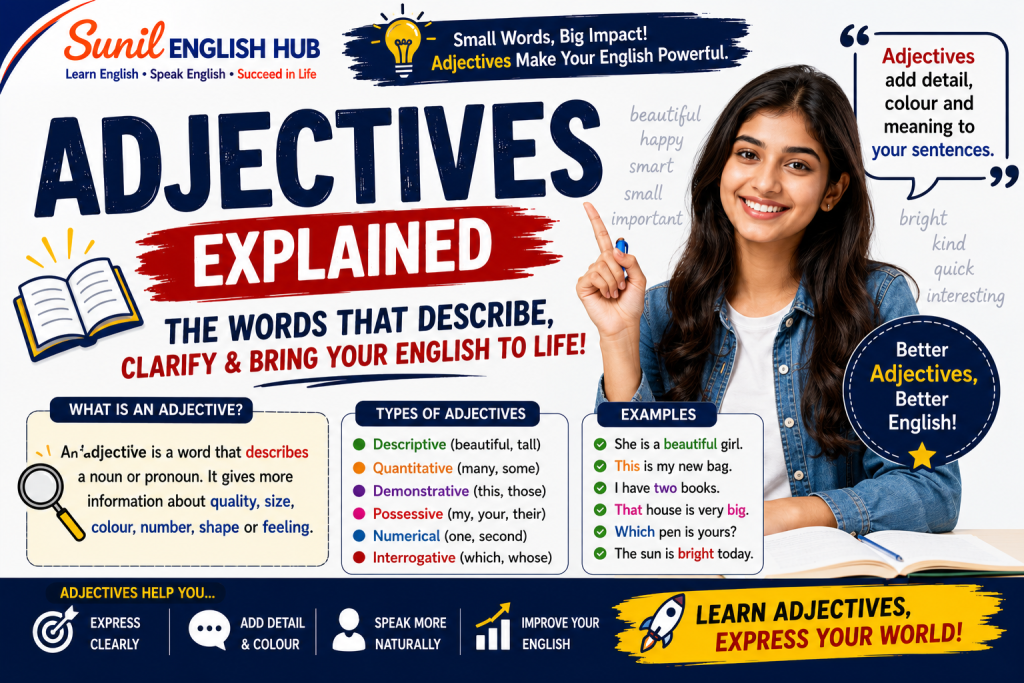
An adjective is a word that describes or modifies a Noun or Pronoun.
It gives more information about:
- Quality
- Size
- Colour
- Shape
- Number
- Feeling
- Condition
Examples
- A beautiful flower
- A small room
- A happy child
- An old building
In each sentence, the adjective gives additional information about the noun.
Why Are Adjectives Important?
Adjectives make communication:
- More clear
- More interesting
- More expressive
- More precise
Compare these:
Without adjective:
She has a dress.
With adjective:
She has a gorgeous blue dress.
The second sentence paints a much stronger image.
Adjectives help speakers express emotions and details more effectively.
Types of Adjectives
English contains several kinds of adjectives. Understanding them helps learners build stronger sentences.
1. Descriptive Adjectives
These describe qualities or characteristics.
Examples
- Beautiful
- Intelligent
- Brave
- Expensive
Sentences
- She is an intelligent student.
- They bought an expensive phone.
These are the most commonly used adjectives in English.
2. Quantitative Adjectives
These show quantity or amount.
Examples
- Some
- Many
- Little
- Enough
Sentences
- We have enough food.
- There are many students here.
3. Demonstrative Adjectives
These point to specific nouns.
Examples
- This
- That
- These
- Those
Sentences
- This book is interesting.
- Those shoes are expensive.
4. Possessive Adjectives
These show ownership.
Examples
- My
- Your
- His
- Her
- Their
Sentences
- My bag is black.
- Their house is beautiful.
5. Numerical Adjectives
These show number or order.
Examples
- One
- Two
- First
- Second
Sentences
- She has two sisters.
- He won the first prize.
6. Interrogative Adjectives
These are used in questions.
Examples
- Which
- What
- Whose
Sentences
- Which book do you want?
- Whose pen is this?
Position of Adjectives in Sentences
Adjectives usually appear before nouns.
Examples
- A smart boy
- A large building
However, adjectives can also appear after linking verbs like:
- is
- am
- are
- seem
- become
Examples
- The sky is blue.
- She seems happy.
Order of Adjectives in English
Sometimes we use multiple adjectives together.
English follows a natural adjective order.
Example
A beautiful small old wooden chair
The usual order is:
- Opinion
- Size
- Age
- Shape
- Colour
- Origin
- Material
- Purpose
Example
A lovely little black leather bag
Native speakers follow this pattern naturally.
Comparative and Superlative Adjectives
Adjectives can compare things.
Comparative Adjectives
Used to compare two things.
Examples
- Tall → taller
- Fast → faster
Sentences
- Ali is taller than Rahim.
- This car is faster than mine.
Superlative Adjectives
Used to compare three or more things.
Examples
- Tall → tallest
- Beautiful → most beautiful
Sentences
- Mount Everest is the highest mountain.
- She is the most talented singer in the group.
Common Mistakes with Adjectives
Learners often make several mistakes while using adjectives.
❌ Using Adverbs Instead of Adjectives
Wrong:
She is beautifully.
Correct:
She is beautiful.
“Beautiful” describes “she,” so we use an adjective.
❌ Wrong Adjective Order
Wrong:
A red small car
Correct:
A small red car
❌ Double Comparatives
Wrong:
More better
Correct:
Better
How to Improve Your Use of Adjectives
1. Read More English
Books, articles, and stories expose you to natural adjective usage.
Helpful resources:
- BBC Learning English
- British Council English resources
2. Learn Adjectives in Groups
Instead of memorising isolated words, learn them by category.
Example
Positive personality adjectives:
- Honest
- Friendly
- Polite
- Confident
3. Use Adjectives in Speaking Practice
Try describing:
- People
- Places
- Food
- Weather
- Movies
The more you use adjectives, the more natural your English becomes.
Examples of Adjectives in Daily Conversation
Talking about food
- The soup is delicious.
- This mango is sweet.
Talking about weather
- Today is hot and humid.
- It was a rainy evening.
Talking about people
- She is very kind.
- He looks tired.
Takeaway
Adjectives are powerful words that improve communication.
They help speakers:
- Describe clearly
- Express emotions
- Add beauty to language
- Speak more naturally
Without adjectives, communication becomes plain and limited.
Learning adjectives is one of the fastest ways to make your English richer and more expressive.
Quick Quiz
Which word is the adjective
The blue sky looked beautiful.
2. Which sentence is correct?
3. What is the comparative form of “happy”?
4. Identify the adjective:
5. Identify the adjective:
Summary
In this lesson, you learned:
- What adjectives are
- Different types of adjectives
- Position and order of adjectives
- Comparative and superlative forms
- Common mistakes to avoid
Adjectives are essential for speaking and writing effective English.
They transform simple sentences into vivid and meaningful communication.
So the next time you speak English, do not just say:
“I saw a bird.”
Say:
“I saw a beautiful colourful bird.”
That is the magic of adjectives.